Every time you eat a plate of rice, beans, plantain or any food that comes from a plant you are benefiting from photosynthesis. It is the process that makes life on earth possible. And it is one of the most common topics in every biology exam.
This guide will explain photosynthesis in the simplest way possible so you understand it deeply enough to answer any exam question on it.
What is Photosynthesis?
Photosynthesis is the process by which green plants use sunlight, water and carbon dioxide to produce their own food in the form of glucose and release oxygen as a byproduct.
Think of it this way — plants are the only living things that can make their own food. They do not need to hunt, farm or buy from a market. They use sunlight as their energy source and raw materials from their environment to cook their own meals. That cooking process is photosynthesis.
Where Does Photosynthesis Happen?
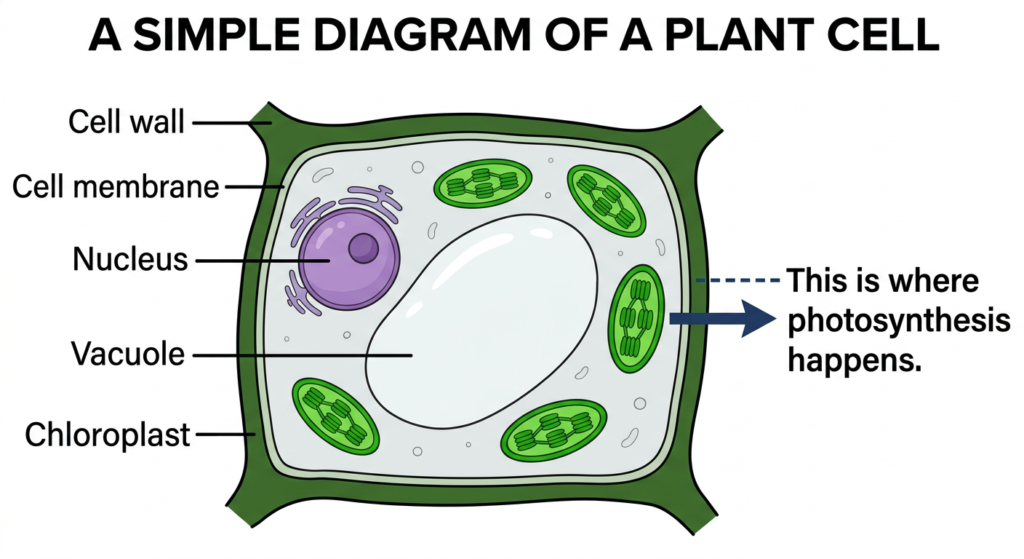
Photosynthesis takes place in the chloroplasts — tiny structures found inside plant cells. Chloroplasts contain a green pigment called chlorophyll which is what gives plants their green colour.
Chlorophyll is the key ingredient. It is the substance that captures sunlight and uses its energy to drive the photosynthesis process.
The Raw Materials and Products of Photosynthesis
Photosynthesis needs three things to work:
- Sunlight — the energy source
- Water — absorbed from the soil through the roots
- Carbon dioxide — absorbed from the air through tiny pores in the leaves called stomata
It produces two things:
- Glucose — the food the plant uses for energy and growth
- Oxygen — released into the air as a byproduct
This is why plants are so important to life on earth. Every breath of oxygen you take was produced by a plant through photosynthesis.
The Equation of Photosynthesis
Every exam student must know this equation. Learn it by heart:
6CO₂ + 6H₂O + Light Energy → C₆H₁₂O₆ + 6O₂
In plain English:
Carbon dioxide + Water + Sunlight → Glucose + Oxygen
Memory tip: Think of it as a recipe. The ingredients are carbon dioxide, water and sunlight. The meal produced is glucose. The steam that escapes during cooking is oxygen.
How Does Water Get Into the Plant?
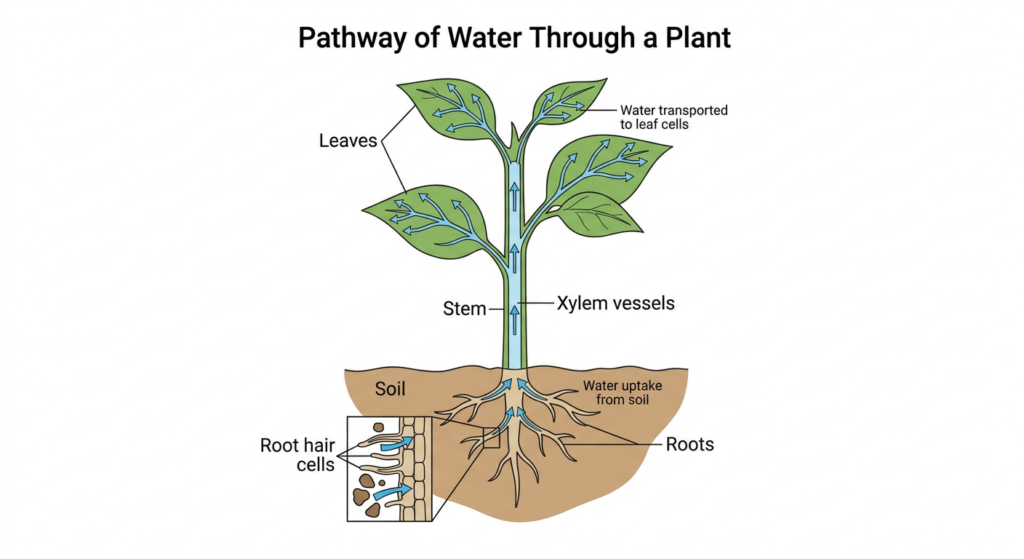
Water is absorbed from the soil by the root hair cells — tiny hair like structures on the roots that increase the surface area for absorption. The water then travels up through the stem via tube like structures called the xylem until it reaches the leaves.
How Does Carbon Dioxide Get Into the Plant?
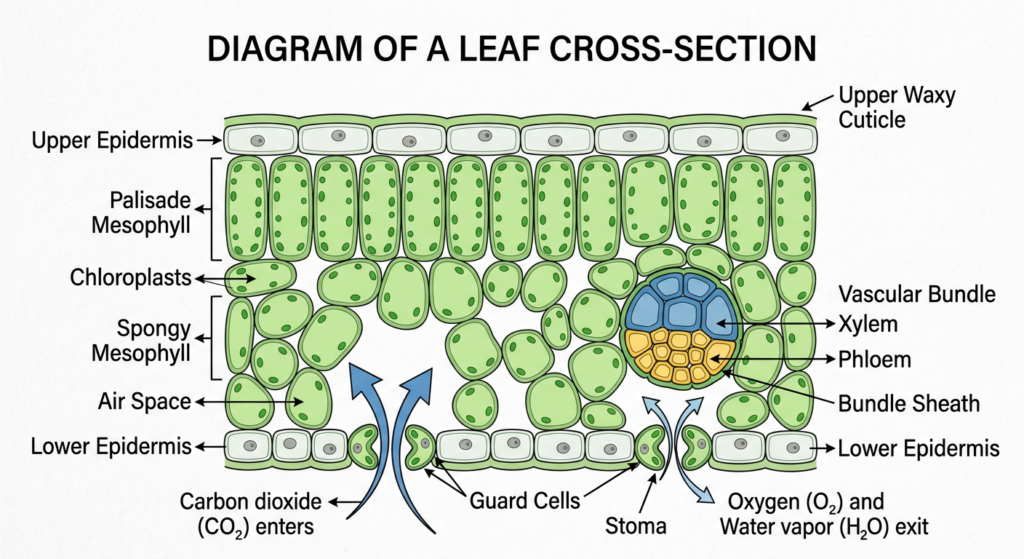
Carbon dioxide enters the leaf through tiny pores called stomata — singular stoma. These pores are mostly found on the underside of leaves. Each stoma is surrounded by two guard cells that control whether the pore is open or closed.
- During the day when sunlight is available the stomata open to let carbon dioxide in
- At night when photosynthesis is not happening the stomata close to prevent water loss
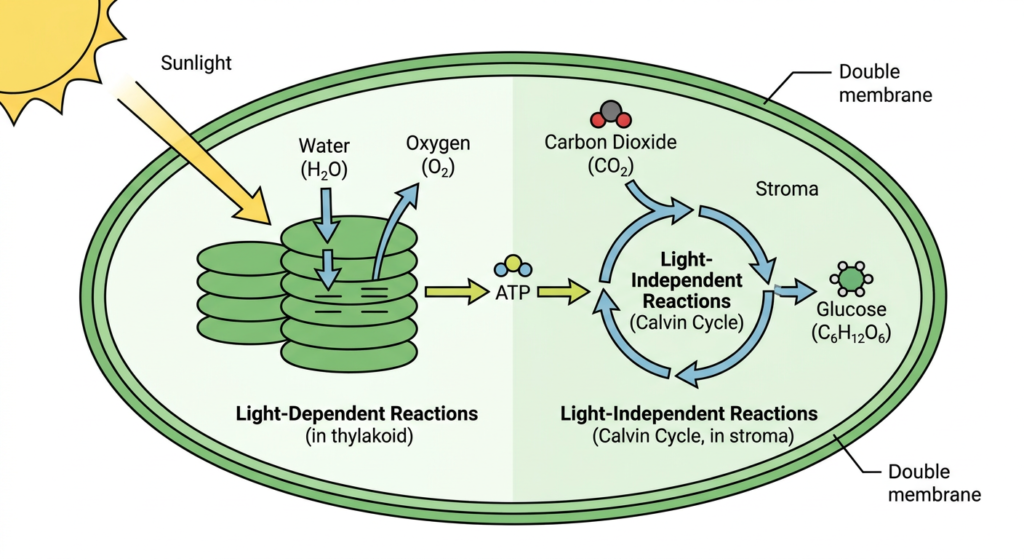
The Two Stages of Photosynthesis
For students studying at a higher level photosynthesis happens in two stages:
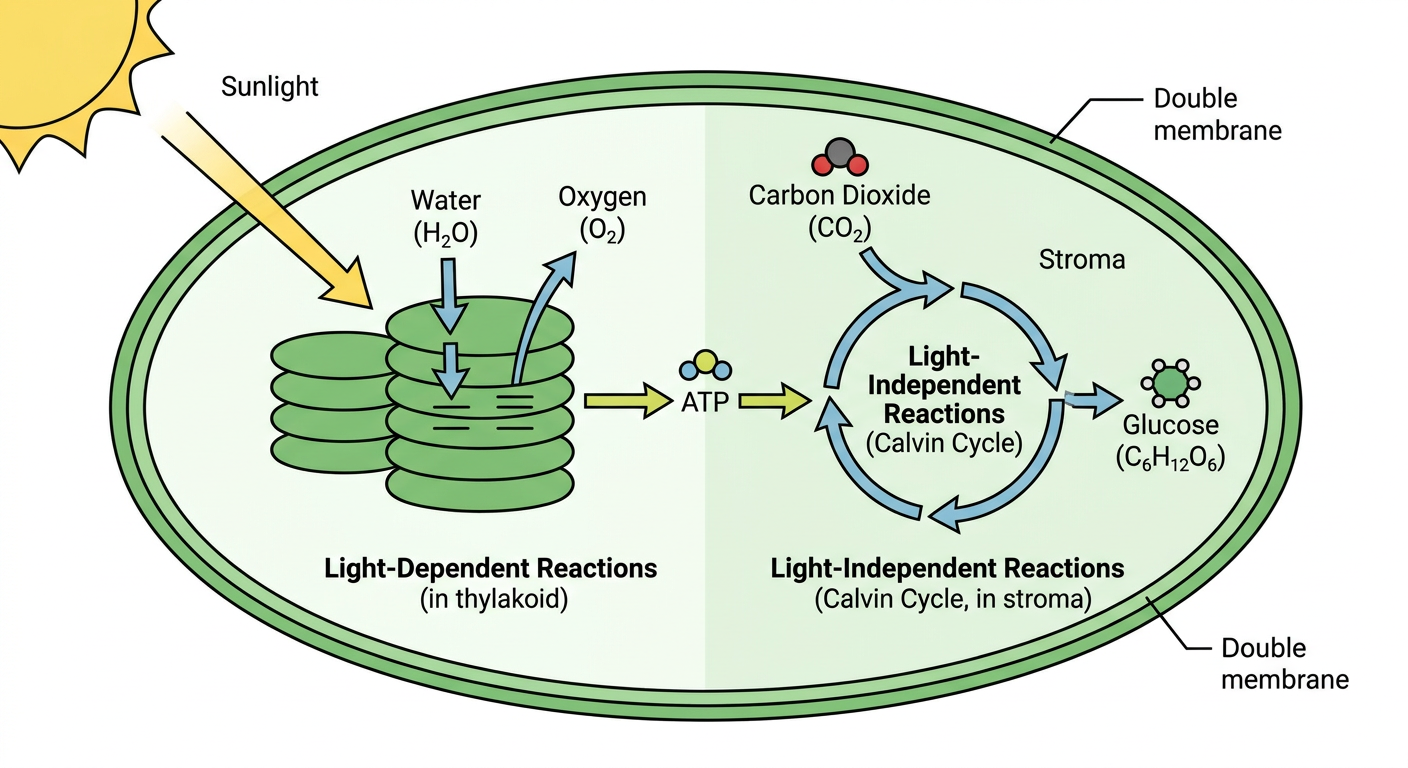
Stage 1: The Light Dependent Reaction
- Takes place in the thylakoid membrane of the chloroplast
- Sunlight splits water molecules into hydrogen and oxygen
- The oxygen is released into the air
- Energy from sunlight is stored as ATP
Stage 2: The Light Independent Reaction (Calvin Cycle)
- Takes place in the stroma of the chloroplast
- Carbon dioxide is combined with hydrogen using the stored energy
- Glucose is produced
Factors That Affect the Rate of Photosynthesis
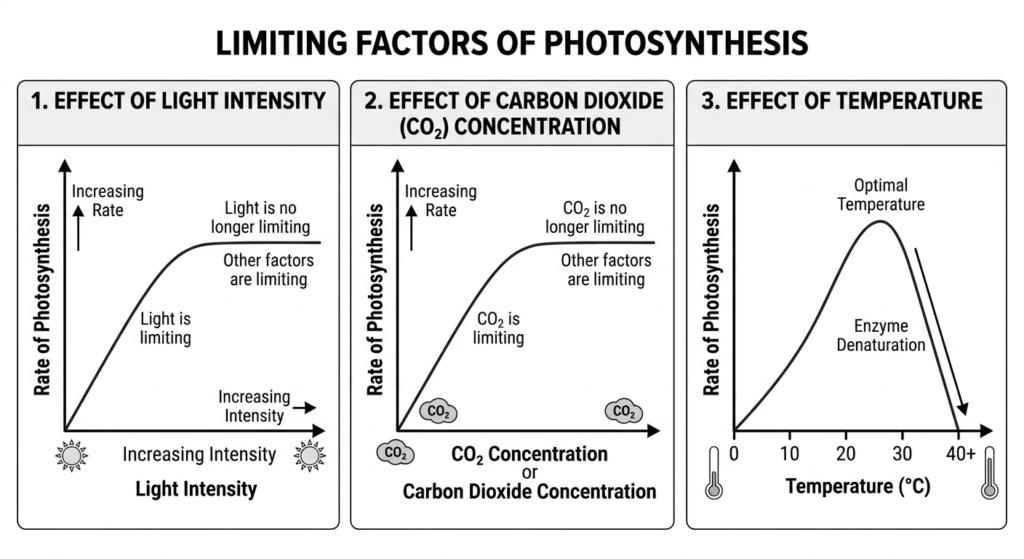
The rate of photosynthesis can speed up or slow down depending on these factors:
1. Light Intensity More light means faster photosynthesis up to a point. Beyond a certain level more light makes no difference.
2. Carbon Dioxide Concentration More carbon dioxide speeds up photosynthesis. This is why plants in greenhouses grow faster when carbon dioxide levels are increased.
3. Temperature Photosynthesis speeds up as temperature rises up to about 40°C. Beyond that the enzymes involved begin to break down and the rate falls sharply.
4. Water Availability Without enough water photosynthesis slows down and eventually stops. Plants in drought conditions close their stomata to save water which also prevents carbon dioxide from entering.
Past Questions
Question 1: State the equation for photosynthesis and explain the role of chlorophyll in the process.
How to answer: Write the equation: 6CO₂ + 6H₂O + Light Energy → C₆H₁₂O₆ + 6O₂. Then explain that chlorophyll is the green pigment found in chloroplasts that absorbs sunlight. It uses the energy from sunlight to split water molecules and drive the production of glucose from carbon dioxide and water. Without chlorophyll the plant cannot capture light energy and photosynthesis cannot occur.
Question 2: Describe an experiment to show that light is necessary for photosynthesis.
How to answer: Describe the variegated leaf experiment or the starch test. Take a potted plant and cover part of one leaf with black paper or foil to block light. Leave the plant in sunlight for several hours. Remove the leaf and test it for starch using iodine solution. The covered part of the leaf will turn orange brown showing no starch was produced — proving light is necessary. The uncovered part will turn blue black showing starch was produced through photosynthesis.
Question 3: Explain how three environmental factors affect the rate of photosynthesis.
How to answer: Choose three factors from the section above — light intensity, carbon dioxide concentration and temperature. For each factor write two to three sentences explaining how it affects the rate and why. Include the concept of limiting factors — the idea that even if one factor is ideal the rate of photosynthesis is limited by whichever factor is in shortest supply.
Conclusion
Photosynthesis is one of the most important processes in biology and one of the most commonly tested topics in your exam. Once you understand the equation, the raw materials, the products and the factors that affect it you can answer virtually any photosynthesis question confidently.
For more biology revision visit our Biology subject page and practise with past questions.
Ready to test yourself? [Take our free photosynthesis quiz] now.