If you typed x² – 4 = 0 into Google you are probably preparing for an exam or doing homework. This is one of the simplest quadratic equations but understanding it from every angle will help you solve harder ones later.
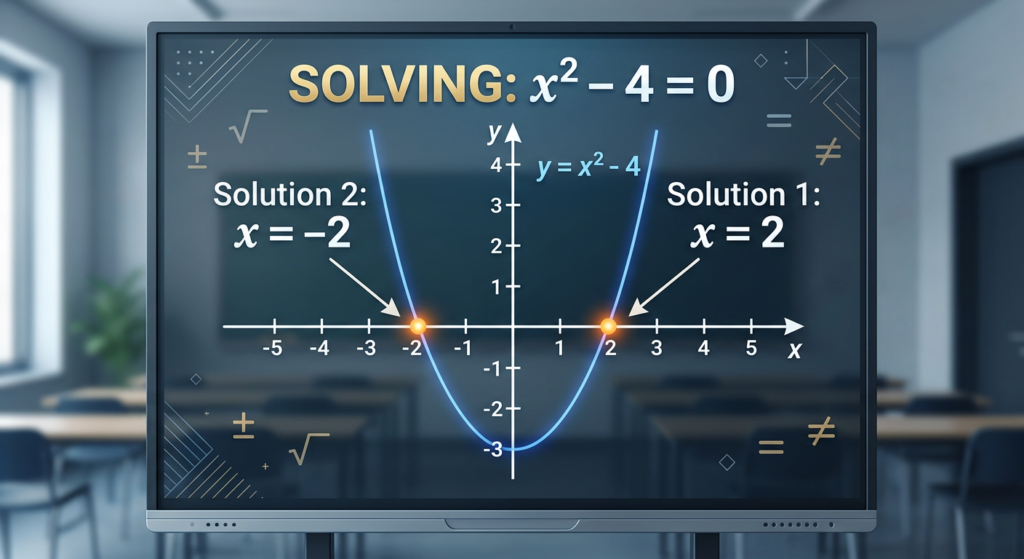
The equation is:
x² – 4 = 0
The answer is x = 2 or x = -2. But showing only the answer is not enough for an exam. You need to know the methods. Here are five different ways to solve it.
Method 1: Square Root Method (Simplest)
This method works when the equation has no x term.
Step 1: Add 4 to both sides
x² – 4 + 4 = 0 + 4
x² = 4
Rule: Whatever you do to one side of the equation you must do to the other side to keep it balanced.
Step 2: Take the square root of both sides
√x² = ±√4
x = ±√4
Rule: √x² = |x| which gives both +x and -x as solutions.
Step 3: Simplify
√4 = 2
x = ±2
Final answer: x = 2 and x = -2
Method 2: Quadratic Formula (Works for Every Quadratic)
This method works for any quadratic equation even the complicated ones. It is good to practise on simple equations so you are ready for harder ones.
The standard form of a quadratic equation is:
ax² + bx + c = 0
Step 1: Identify a, b and c
For x² – 4 = 0:
- a = 1 (coefficient of x²)
- b = 0 (there is no x term)
- c = -4 (constant term)
Step 2: Write the quadratic formula
x = (-b ± √(b² – 4ac)) ÷ 2a
The part under the square root — b² – 4ac — is called the discriminant. It tells you how many solutions to expect.
Step 3: Substitute the values
x = (-(0) ± √((0)² – 4(1)(-4))) ÷ 2(1)
x = (0 ± √(0 – (-16))) ÷ 2
x = (± √16) ÷ 2
Step 4: Simplify
√16 = 4
x = ±4 ÷ 2
x = ±2
Final answer: x = 2 and x = -2
Method 3: Difference of Squares (Fastest for This Type)
This method uses a special factoring rule. It works whenever you have one square subtracted from another square.
Formula to remember:
a² – b² = (a – b)(a + b)
This is called the difference of squares formula.
Step 1: Recognise the equation as a difference of squares
x² – 4 = 0
Write 4 as 2²:
x² – 2² = 0
Now it clearly matches a² – b² with a = x and b = 2.
Step 2: Apply the formula
(x – 2)(x + 2) = 0
Step 3: Use the zero product property
Rule: If the product of two factors is zero at least one of the factors must be zero.
x – 2 = 0 or x + 2 = 0
Step 4: Solve each equation
x – 2 = 0 → x = 2
x + 2 = 0 → x = -2
Final answer: x = 2 and x = -2
Method 4: Factoring by Finding Factors of ac That Sum to b
This method works for any quadratic. It is the thinking behind factoring.
Step 1: Identify a, b and c
a = 1, b = 0, c = -4
Step 2: Find ac
a × c = 1 × (-4) = -4
Step 3: Find two numbers whose product is ac (-4) and whose sum is b (0)
Think: What two numbers multiply to give -4 and add to give 0?
| Factor Pair | Product | Sum |
|---|---|---|
| 1 and -4 | -4 | -3 ❌ |
| -1 and 4 | -4 | 3 ❌ |
| 2 and -2 | -4 | 0 ✅ |
The numbers are 2 and -2.
Step 4: Rewrite and factor
x² – 4 = (x + 2)(x – 2) = 0
Step 5: Zero product rule
x + 2 = 0 → x = -2
x – 2 = 0 → x = 2
Final answer: x = 2 and x = -2
Method 5: Solving by Recognition (No Formal Algebra)
Sometimes you can solve just by thinking about what the equation means.
The equation x² – 4 = 0 asks: what number squared minus 4 equals zero?
That is the same as asking: what number squared equals 4?
x² = 4
Now think: which numbers when multiplied by themselves give 4?
2 × 2 = 4
(-2) × (-2) = 4
So x = 2 or x = -2.
Final answer: x = 2 and x = -2
This method is fast but only works for simple equations. Use the other methods to build skills for harder questions.
Summary Table of Methods
| Method | Best Used When | Difficulty |
|---|---|---|
| Square root method | No x term (b = 0) | Very easy |
| Quadratic formula | Any quadratic equation | Medium |
| Difference of squares | Perfect squares subtracted | Easy |
| Factoring (ac method) | a is small and factors exist | Medium |
| Recognition | Very simple equations | Very easy |
Key Formulas and Rules to Remember
| Formula or Rule | When to Use |
|---|---|
| x = (-b ± √(b² – 4ac)) ÷ 2a | Quadratic formula for any ax² + bx + c = 0 |
| a² – b² = (a – b)(a + b) | Difference of squares |
| If AB = 0 then A = 0 or B = 0 | After factoring |
| √x² = ±x | Taking square roots of both sides |
| D = b² – 4ac | Tells number of real solutions |
Common Mistakes to Avoid
| Mistake | Why It Is Wrong | Correct Way |
|---|---|---|
| √4 = ±2 only | The square root symbol by itself means only the positive answer | √4 = 2 but x² = 4 gives x = ±2 |
| Forgetting the negative solution | Quadratic equations can have two answers | Always include + and – when taking square roots |
| Writing x = √4 only | Misses the solution x = -2 | Write x = ±√4 |
| Mixing up a, b, c signs | c = -4 not 4 | Standard form is ax² + bx + c = 0 |
Practice Questions (Try These Yourself)
After solving x² – 4 = 0 try these similar equations:
| Equation | Answer |
|---|---|
| x² – 9 = 0 | x = ±3 |
| x² – 16 = 0 | x = ±4 |
| x² – 25 = 0 | x = ±5 |
| x² – 1 = 0 | x = ±1 |
| x² – 49 = 0 | x = ±7 |
Notice the pattern: x² – k² = 0 always gives x = ±k.
Why Understanding This Equation Matters
x² – 4 = 0 is the simplest example of a quadratic equation. But the methods you learn here apply to every quadratic you will ever see:
- The square root method works when there is no x term
- The quadratic formula works for everything
- Difference of squares is a fast trick for special cases
- Factoring is the skill you will use most in exams
Master these methods on simple equations and the harder ones will make sense.
For more help with mathematics read our posts on [algebra solving equations step by step] and [quadratic formula worked examples].
Learn how to read and remember
Ready to test yourself? [Take our free quiz] and see where y