If you already know what acids and bases are from everyday life then you are halfway to understanding this topic. Lemon juice is an acid. Baking soda is a base. The soap you use to wash your hands is a base. Chemistry simply gives these everyday things proper names and explains why they behave the way they do.
Here are every term and definition you must know for your exam.
Acid
A substance that produces hydrogen ions (H⁺) when dissolved in water. Acids have a sour taste, turn blue litmus paper red and have a pH below 7.
Real life example: Lemon juice, vinegar and battery acid are all acids you encounter in everyday life.
Base
A substance that produces hydroxide ions (OH⁻) when dissolved in water. Bases feel soapy to touch, turn red litmus paper blue and have a pH above 7.
Real life example: Baking soda, soap and toothpaste are all bases.
Alkali
A base that dissolves in water. All alkalis are bases but not all bases are alkalis.
Memory tip: Think of alkali as a base that can swim — it dissolves in water.
Neutralisation
The chemical reaction between an acid and a base that produces a salt and water only.
Equation: Acid + Base → Salt + Water
Real life example: When you take an antacid tablet for a stomach ache you are neutralising the excess acid in your stomach with a base.
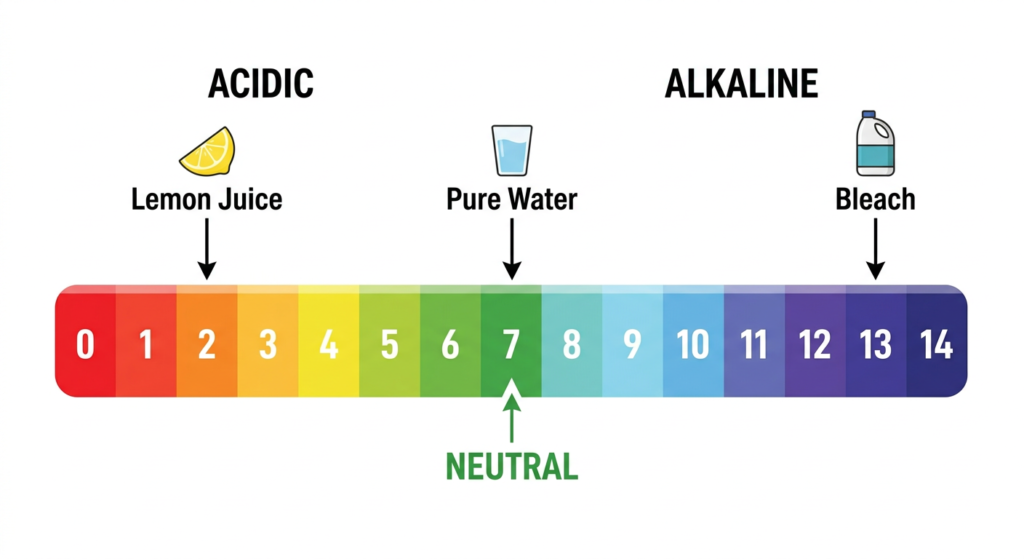
pH Scale
A scale from 0 to 14 used to measure how acidic or alkaline a substance is.
- pH 0 to 6 — Acidic
- pH 7 — Neutral
- pH 8 to 14 — Alkaline
Indicator
A substance that changes colour depending on whether a solution is acidic or alkaline.
Common indicators:
- Litmus — turns red in acid, blue in alkali
- Phenolphthalein — colourless in acid, pink in alkali
- Methyl orange — red in acid, yellow in alkali
- Universal indicator — shows full range of colours matching the pH scale
Strong Acid
An acid that completely dissociates in water producing a large number of hydrogen ions.
Examples: Hydrochloric acid (HCl), Sulphuric acid (H₂SO₄), Nitric acid (HNO₃)
Weak Acid
An acid that only partially dissociates in water producing fewer hydrogen ions.
Examples: Ethanoic acid (vinegar), Citric acid (lemon juice), Carbonic acid (fizzy drinks)
Strong Alkali
An alkali that completely dissociates in water producing a large number of hydroxide ions.
Examples: Sodium hydroxide (NaOH), Potassium hydroxide (KOH)
Weak Alkali
An alkali that only partially dissociates in water.
Examples: Ammonia solution (NH₃)
Salt
A compound formed when the hydrogen ions of an acid are replaced by metal ions during neutralisation.
Example: Hydrochloric acid + Sodium hydroxide → Sodium chloride + Water HCl + NaOH → NaCl + H₂O
Titration
A laboratory technique used to find the exact volume of an acid needed to neutralise a known volume of alkali or vice versa.
Concentration
The amount of solute dissolved in a given volume of solution. Measured in mol/dm³ or g/dm³.
Dissociation
The process by which an ionic compound separates into its ions when dissolved in water.
Amphoteric
A substance that can act as both an acid and a base depending on what it reacts with.
Example: Water (H₂O) and Aluminium oxide (Al₂O₃)
Corrosive
A property of strong acids and alkalis that means they can destroy living tissue and materials on contact.
Common Exam Questions
Question 1: Define an acid and a base and state two differences between them.
How to answer: Define acid as a substance that produces H⁺ ions in water. Define base as a substance that produces OH⁻ ions in water. Two differences — acids turn blue litmus red while bases turn red litmus blue. Acids have pH below 7 while bases have pH above 7.
Question 2: Explain what happens during a neutralisation reaction and write a general equation.
How to answer: Explain that an acid and a base react together producing a salt and water. Neither acidic nor alkaline properties remain in the product. General equation: Acid + Base → Salt + Water.
Question 3: A student tests four solutions with universal indicator and gets these colours — red, green, orange, purple. Arrange them from most acidic to most alkaline.
How to answer: Red = strongly acidic, Orange = weakly acidic, Green = neutral, Purple = alkaline. Order from most acidic: Red → Orange → Green → Purple.
Conclusion
Acids and bases appear in virtually every aspect of everyday life and in virtually every Chemistry exam. Master these definitions now and questions on this topic will feel straightforward on exam day.
For more Chemistry revision visit our Chemistry subject page and test yourself with our [Acids and Bases quiz].