Everything in the universe — the air you breathe, the water you drink, the phone in your hand — is made of atoms. Atomic structure is simply the study of what is inside these tiny particles and how they are arranged. Once you understand the atom everything else in Chemistry starts to make sense.
Here are every term and definition you must know for your exam.
Atom
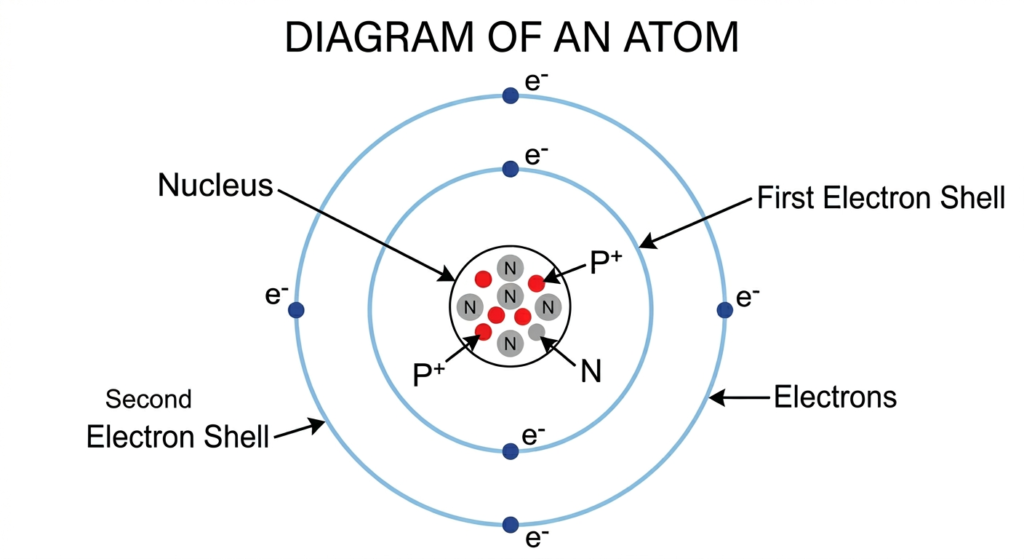
The smallest particle of an element that can take part in a chemical reaction. Atoms are made up of three subatomic particles — protons, neutrons and electrons.
Real life example: A single grain of sand contains more atoms than there are grains of sand on all the beaches of the world combined.
Proton
A positively charged subatomic particle found in the nucleus of an atom. Relative mass of 1 and relative charge of +1.
Memory tip: Proton = Positive. Both start with P.
Neutron
A neutral subatomic particle found in the nucleus of an atom alongside protons. Relative mass of 1 and relative charge of 0.
Memory tip: Neutron = Neutral. Both start with N.
Electron
A negatively charged subatomic particle that orbits the nucleus of an atom in shells or energy levels. Relative mass of approximately 0 and relative charge of -1.
Memory tip: Electron = nEgativE. Both contain E.
Nucleus
The dense central core of an atom containing protons and neutrons. The nucleus is positively charged overall because of the protons it contains.
Atomic Number
The number of protons in the nucleus of an atom. Also called the proton number. Every element has a unique atomic number.
Example: Carbon has atomic number 6 meaning every carbon atom has exactly 6 protons.
Mass Number
The total number of protons and neutrons in the nucleus of an atom. Also called the nucleon number.
Formula: Mass Number = Protons + Neutrons
Example: Carbon has mass number 12 — 6 protons and 6 neutrons.
Element
A pure substance made up of only one type of atom that cannot be broken down into simpler substances by chemical means.
Examples: Oxygen, Gold, Iron, Carbon
Electronic Configuration
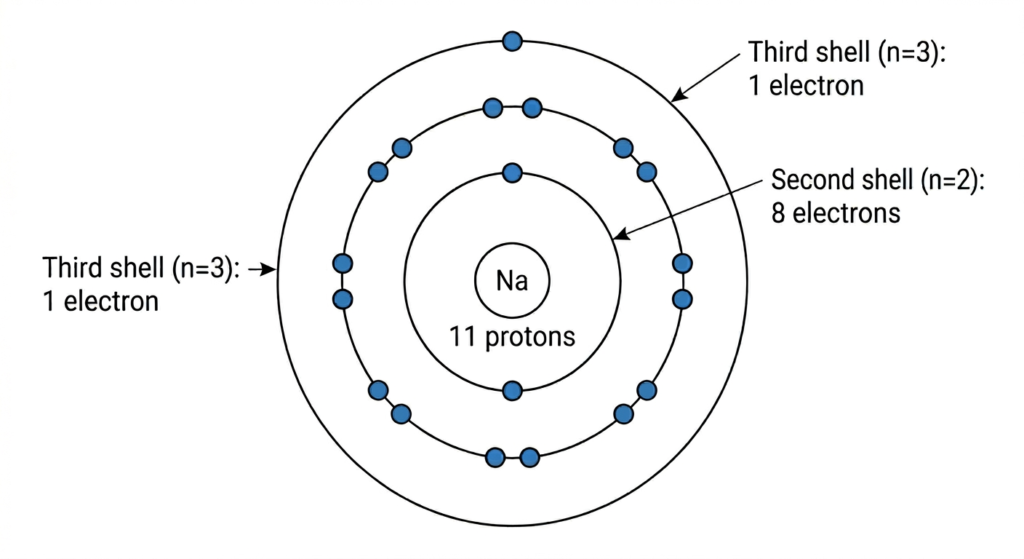
The arrangement of electrons in the shells or energy levels around the nucleus of an atom.
Rules:
- First shell holds maximum 2 electrons
- Second shell holds maximum 8 electrons
- Third shell holds maximum 8 electrons
Example: Sodium (atomic number 11) has electronic configuration 2.8.1
Isotopes
Atoms of the same element that have the same number of protons but different numbers of neutrons. Isotopes have the same atomic number but different mass numbers.
Example: Carbon-12 and Carbon-14 are both carbon atoms with 6 protons but Carbon-12 has 6 neutrons while Carbon-14 has 8 neutrons.
Real life example: Carbon-14 is used in radioactive dating to determine the age of ancient objects and fossils.
Ion
An atom or group of atoms that has gained or lost electrons and therefore carries an electrical charge.
- Cation — a positively charged ion formed when an atom loses electrons
- Anion — a negatively charged ion formed when an atom gains electrons
Example: Sodium loses one electron to form Na⁺ (cation). Chlorine gains one electron to form Cl⁻ (anion).
Valence Electrons
The electrons in the outermost shell of an atom. These electrons are responsible for chemical bonding and determine the chemical properties of an element.
Example: Sodium has 1 valence electron. Oxygen has 6 valence electrons.
Periodic Table
A table that arranges all known elements in order of increasing atomic number. Elements are arranged in rows called periods and columns called groups.
- Elements in the same group have the same number of valence electrons and similar chemical properties
- Elements in the same period have the same number of electron shells
Period
A horizontal row in the periodic table. Elements in the same period have the same number of electron shells.
Example: Sodium, Magnesium and Chlorine are all in Period 3 — they all have 3 electron shells.
Group
A vertical column in the periodic table. Elements in the same group have the same number of valence electrons and similar chemical properties.
Example: Group 1 elements — Lithium, Sodium, Potassium — all have 1 valence electron and all react vigorously with water.
Relative Atomic Mass
The average mass of an atom of an element compared to one twelfth of the mass of a carbon-12 atom.
Common Exam Questions
Question 1: An element has atomic number 17 and mass number 35. State the number of protons, neutrons and electrons in a neutral atom of this element and write its electronic configuration.
How to answer: Protons = atomic number = 17. Neutrons = mass number – atomic number = 35 – 17 = 18. Electrons = protons = 17 (neutral atom). Electronic configuration = 2.8.7.
Question 2: Define isotopes and explain why isotopes of the same element have similar chemical properties but different physical properties.
How to answer: Define isotopes as atoms of the same element with the same number of protons but different numbers of neutrons. They have similar chemical properties because they have the same number of valence electrons — chemical properties depend on electrons not neutrons. They have different physical properties such as mass and density because they have different numbers of neutrons giving them different mass numbers.
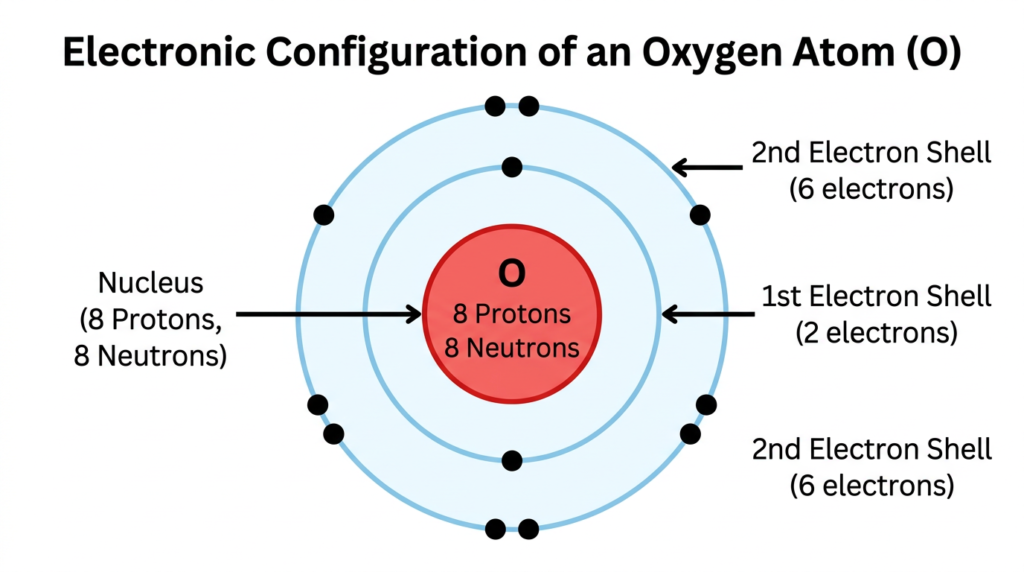
Question 3: Draw and label the electronic configuration of oxygen (atomic number 8).
How to answer: Draw two shells around a nucleus. First shell has 2 electrons. Second shell has 6 electrons. Label the nucleus, both shells and the electrons. Configuration = 2.6.
Conclusion
Atomic structure is the foundation of all Chemistry. Every topic you study from chemical bonding to electrolysis builds on what you learn here. Master these definitions and diagrams and you will have a strong base for your entire Chemistry exam.
For more Chemistry revision read our post on [Acids and Bases key terms] and test yourself with our [Atomic Structure quiz].