
Every time your mother strains rice from water or filters palm oil through a cloth she is using a separation technique. Chemistry simply takes these everyday processes and gives them proper names and explanations. Separation techniques are used to separate mixtures into their individual components and they appear in virtually every Chemistry exam.
Here are every term and definition you must know for your exam.
Mixture
A combination of two or more substances that are not chemically combined and can be separated by physical methods.
Examples: Salt and water, sand and water, air, crude oil
Real life example: The air you breathe is a mixture of nitrogen, oxygen, carbon dioxide and other gases — each can be separated and collected individually.
Pure Substance
A substance that contains only one type of particle — either a single element or a single compound. Pure substances have fixed melting and boiling points.
Examples: Pure water, pure gold, pure sodium chloride
Filtration
A separation technique used to separate an insoluble solid from a liquid. The mixture is poured through filter paper in a funnel. The liquid passes through as filtrate while the solid remains as residue.
Real life example: Filtering dirty water through sand and gravel to remove solid particles. Water treatment plants use filtration on a large scale.
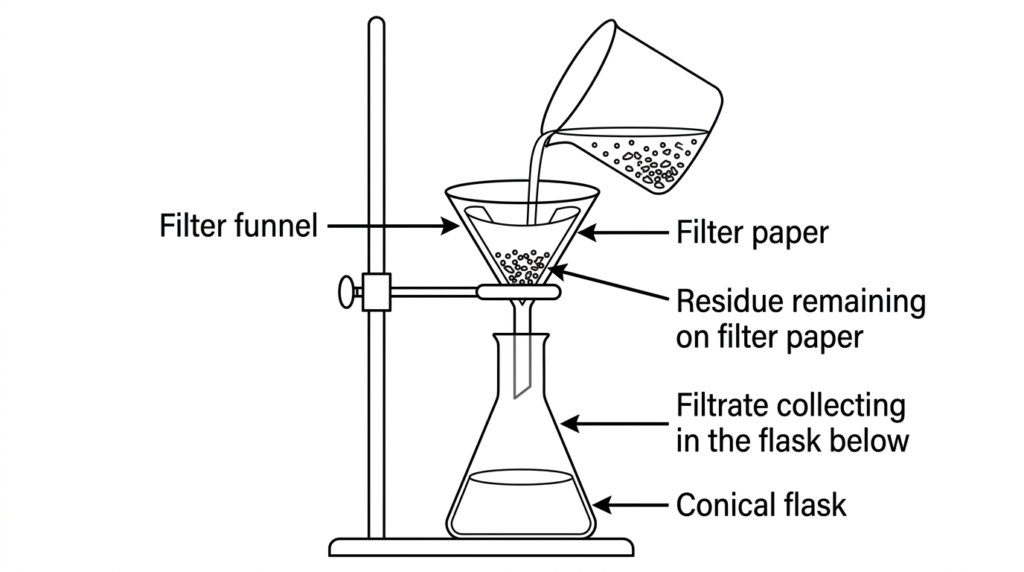
Filtrate
The liquid that passes through the filter paper during filtration.
Residue
The solid that remains on the filter paper after filtration.
Evaporation
A separation technique used to separate a soluble solid from a liquid by heating the mixture until the liquid turns to vapour and escapes leaving the solid behind.
Real life example: Salt is obtained from sea water by evaporation — the water evaporates leaving behind salt crystals. Salt pans along African coastlines use this method.
Crystallisation
A separation technique used to obtain pure crystals of a soluble solid from a solution. The solution is heated to evaporate some of the liquid then allowed to cool slowly. As it cools the dissolved solid forms pure crystals.
Real life example: Sugar crystals are produced by crystallisation from sugar cane juice.
Difference between evaporation and crystallisation: Evaporation removes all the liquid quickly. Crystallisation removes liquid slowly and produces pure well-formed crystals.
Distillation
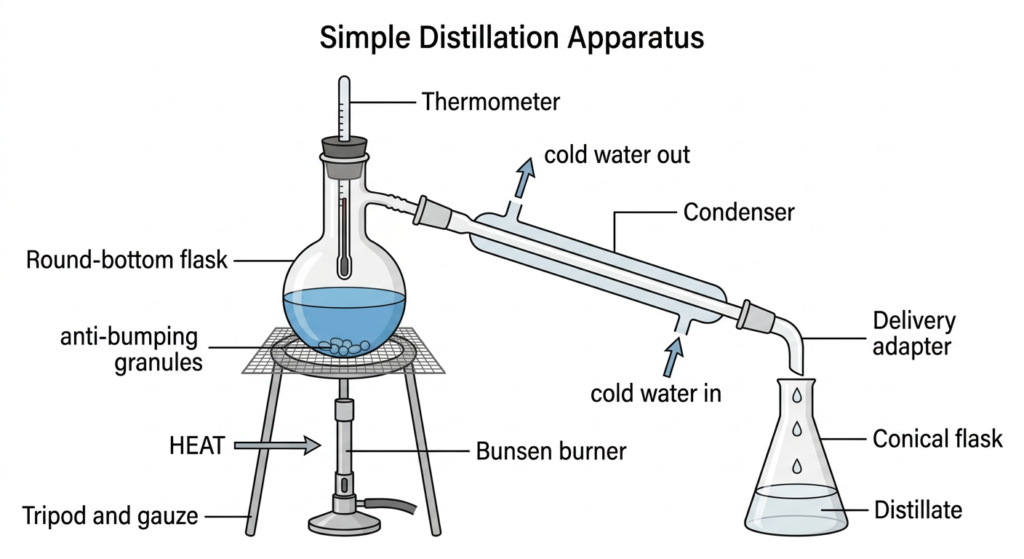
A separation technique used to separate a liquid from a solution or to separate liquids with different boiling points. The mixture is heated, the liquid with the lower boiling point vaporises first, the vapour passes through a condenser where it cools and turns back into liquid and is collected as the distillate.
Real life example: Distilled water is produced by distilling tap water — the water evaporates leaving dissolved salts behind and pure water is collected.
Fractional Distillation
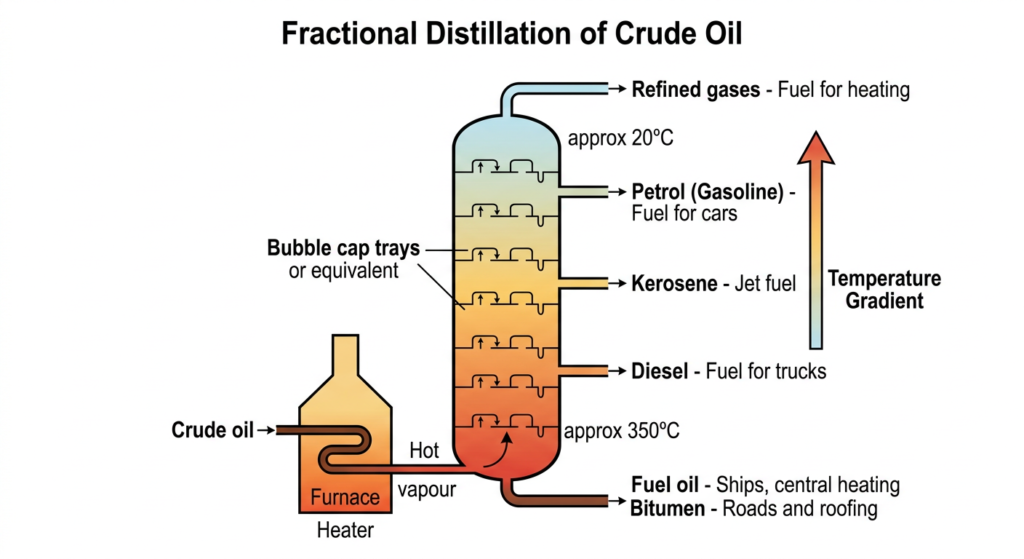
A separation technique used to separate a mixture of liquids that have different but close boiling points. A fractionating column is used to improve the separation.
Real life example: Crude oil is separated into petrol, diesel, kerosene and other products by fractional distillation in oil refineries. This is one of the most important industrial processes in the world.
Condenser
A piece of laboratory equipment used in distillation to cool vapour back into liquid. Cold water flows through the outer jacket of the condenser cooling the vapour in the inner tube.
Chromatography
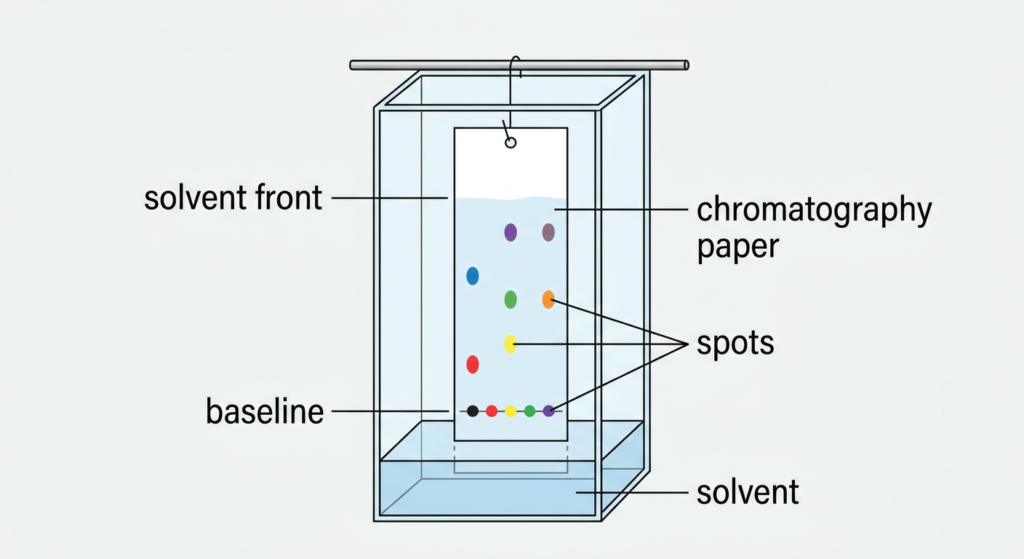
A separation technique used to separate mixtures of soluble substances based on how strongly they are attracted to a stationary phase compared to a mobile phase. Used to identify substances and test for purity.
Real life example: Chromatography is used in food testing laboratories to detect artificial colourings in food and drinks. It is also used in forensic science to analyse evidence.
Stationary Phase
The material that does not move during chromatography. In paper chromatography the stationary phase is the paper itself.
Mobile Phase
The solvent that moves through the stationary phase during chromatography carrying the components of the mixture with it.
Rf Value
The ratio of the distance travelled by a substance to the distance travelled by the solvent front in chromatography. Used to identify substances by comparing with known values.
Formula: Rf = Distance travelled by substance ÷ Distance travelled by solvent front
Rf values are always between 0 and 1.
Solvent Extraction
A separation technique used to separate a substance from a mixture by dissolving it in a suitable solvent that does not mix with the original liquid.
Sublimation
A separation technique used to separate a substance that sublimes — turns directly from solid to gas without passing through the liquid state — from a mixture of non-subliming substances.
Example: Separating iodine from a mixture of iodine and sand. Iodine sublimes when heated and can be collected on a cold surface above.
Centrifugation
A separation technique that uses a centrifuge machine to spin mixtures at high speed. The denser components are forced to the bottom of the tube while lighter components remain at the top. Used when filtration is too slow.
Real life example: Centrifugation is used in hospitals to separate blood into its components — red blood cells, white blood cells and plasma.
Decanting
The process of carefully pouring off a liquid from a solid that has settled at the bottom of a container without disturbing the solid.
Real life example: Pouring palm wine carefully from a bottle leaving the sediment at the bottom is decanting.
Common Exam Questions
Question 1: Describe how you would obtain pure dry salt from a mixture of salt and sand.
How to answer: Step 1 — Add water to the mixture and stir. Salt dissolves but sand does not. Step 2 — Filter the mixture. Sand remains as residue on the filter paper. Salt solution passes through as filtrate. Step 3 — Heat the filtrate in an evaporating dish to evaporate the water. Pure salt crystals remain. For dry salt heat gently to remove all remaining moisture.
Question 2: Explain how paper chromatography works and describe how you would use it to identify an unknown dye.
How to answer: Paper chromatography separates substances based on how strongly they are attracted to the paper compared to the solvent. Draw a pencil baseline on chromatography paper and place a spot of the unknown dye on it. Place the paper in a solvent so the baseline is just above the solvent level. As the solvent rises it carries the components of the dye at different rates. Calculate the Rf value for each spot — distance travelled by spot divided by distance travelled by solvent front. Compare Rf values with those of known substances to identify the unknown dye.
Question 3: State the separation technique you would use for each of the following and give a reason for each choice: a) Separating petrol from crude oil b) Separating sand from water c) Separating salt from sea water
How to answer: a) Fractional distillation — because petrol and other components of crude oil have different boiling points and fractional distillation separates liquids based on boiling point differences. b) Filtration — because sand is an insoluble solid and filtration separates insoluble solids from liquids. c) Evaporation — because salt is a soluble solid dissolved in water and evaporation removes the water leaving the salt behind.
Conclusion
Separation techniques are among the most practical topics in Chemistry. Every technique has a specific purpose and is chosen based on the properties of the mixture being separated. Master these definitions, understand when to use each technique and you will be well prepared for any separation question in your exam.
For more Chemistry revision read our posts on [Electrolysis key terms] and [Chemical Bonding key terms]. Test yourself with our [Separation Techniques quiz].