
Have you ever wondered why you can smell food cooking from another room? Or why a drop of ink spreads through water on its own without stirring? The answers lie in the Kinetic Theory — one of the most powerful ideas in all of science. It explains the behaviour of every substance you have ever encountered using one simple idea — particles are always moving.
Here are every term and definition you must know for your exam.
Kinetic Theory of Matter
The theory that all matter is made up of tiny particles — atoms, molecules or ions — that are in constant random motion. The energy of this motion is called kinetic energy. The higher the temperature the faster the particles move and the greater their kinetic energy.
The three main assumptions of kinetic theory:
- All matter consists of tiny particles
- These particles are in constant random motion
- Temperature is a measure of the average kinetic energy of the particles
Kinetic Energy
The energy a particle possesses due to its motion. Kinetic energy increases with temperature — hotter particles move faster and have more kinetic energy.
Formula: Kinetic Energy = ½ × mass × velocity²
Real life example: Hot water feels hotter than cold water because the particles in hot water are moving faster and have more kinetic energy.
Temperature
A measure of the average kinetic energy of the particles in a substance. The higher the temperature the faster the particles move on average.
Note: Temperature measures the average kinetic energy — not all particles move at the same speed. Some move faster and some slower than the average.
Pressure
In gases pressure is caused by the constant bombardment of gas particles on the walls of their container. The more frequent and forceful these collisions the higher the pressure.
Real life example: The pressure inside a football is caused by the constant random collisions of air particles against the inside of the ball.
Brownian Motion
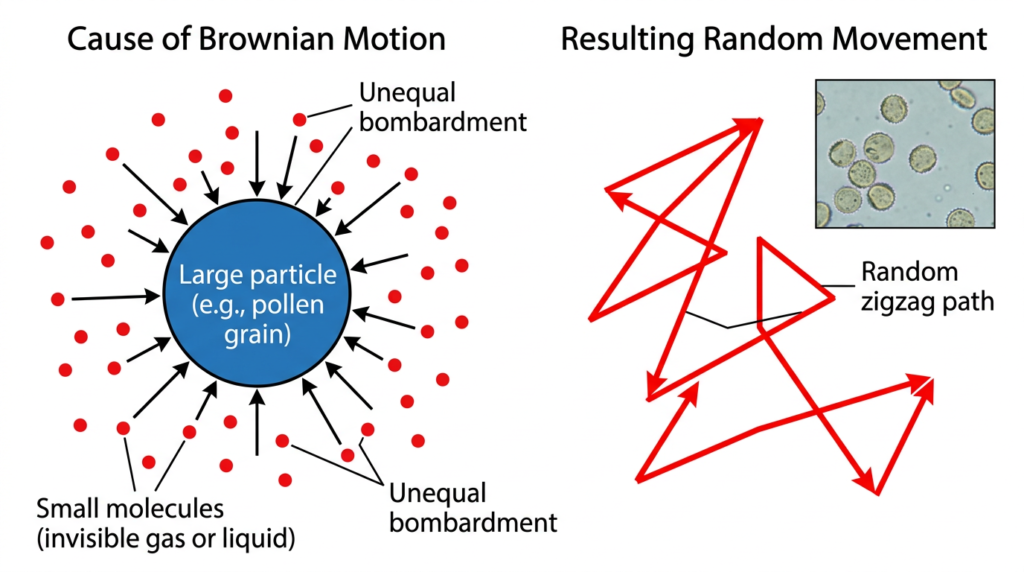
The random irregular zigzag movement of small visible particles suspended in a liquid or gas. This movement is caused by unequal bombardment of the visible particles by the much smaller invisible molecules surrounding them.
Historical note: Brownian motion was first observed by scientist Robert Brown in 1827 when he noticed pollen grains moving randomly in water under a microscope.
Significance: Brownian motion provides direct evidence that the particles of matter are in constant random motion — one of the key assumptions of kinetic theory.
Evidence for Kinetic Theory
Several observations provide evidence that particles are in constant random motion:
1. Brownian motion — random movement of particles suspended in a fluid 2. Diffusion — spontaneous mixing of substances without stirring 3. Evaporation — liquids lose particles from their surface at all temperatures 4. Gas pressure — caused by particle collisions with container walls 5. Dissolving — solutes spread throughout a solvent without stirring
Diffusion
The net movement of particles from a region of higher concentration to a region of lower concentration as a result of random particle motion. Diffusion continues until the concentration is equal throughout — this is called equilibrium.
Key points about diffusion:
- Diffusion is a passive process — it requires no energy input
- It occurs in both gases and liquids
- It does not occur in solids because particles cannot move freely
- The rate of diffusion depends on temperature, particle size and concentration gradient
Real life example: When you spray air freshener in one corner of a room the smell gradually spreads to the entire room through diffusion.
Concentration Gradient
The difference in concentration between two regions. Particles always diffuse down a concentration gradient — from high concentration to low concentration. The steeper the concentration gradient the faster the rate of diffusion.
Rate of Diffusion
How quickly diffusion occurs. Affected by these factors:
1. Temperature — higher temperature means faster moving particles and faster diffusion 2. Particle size — smaller particles diffuse faster than larger ones 3. Concentration gradient — steeper gradient means faster diffusion 4. Medium — diffusion is faster in gases than in liquids because gas particles move more freely
Graham’s Law of Diffusion
The rate of diffusion of a gas is inversely proportional to the square root of its relative molecular mass. This means lighter gases diffuse faster than heavier gases.
Formula: Rate₁ ÷ Rate₂ = √(M₂ ÷ M₁)
Where M₁ and M₂ are the relative molecular masses of the two gases.
Example: Hydrogen gas (M = 2) diffuses much faster than oxygen gas (M = 32) because hydrogen molecules are much lighter.
Effusion
The process by which gas particles escape through a tiny hole into a region of lower pressure. Like diffusion lighter gases effuse faster than heavier gases following Graham’s Law.
Real life example: A balloon filled with helium deflates faster than one filled with air because helium atoms are smaller and lighter and effuse through the tiny pores in the balloon faster.
Mean Free Path
The average distance a particle travels between collisions with other particles. In gases the mean free path is much longer than in liquids because gas particles are more widely spaced.
Osmosis
A special type of diffusion involving the movement of water molecules only through a selectively permeable membrane from a region of high water concentration to a region of low water concentration.
Real life example: Plant roots absorb water from the soil through osmosis — water moves from the dilute soil solution into the more concentrated root cells.
Selectively Permeable Membrane
A membrane that allows certain particles to pass through but not others. In osmosis only water molecules can pass through — dissolved solute particles cannot.
Turgor Pressure
The pressure exerted by water inside a plant cell against the cell wall as water enters by osmosis. Turgor pressure keeps plant cells firm and gives plants their structure.
Real life example: A fresh vegetable is firm because its cells are turgid — full of water under pressure. A wilted vegetable has lost water and its cells are no longer turgid.
Common Exam Questions
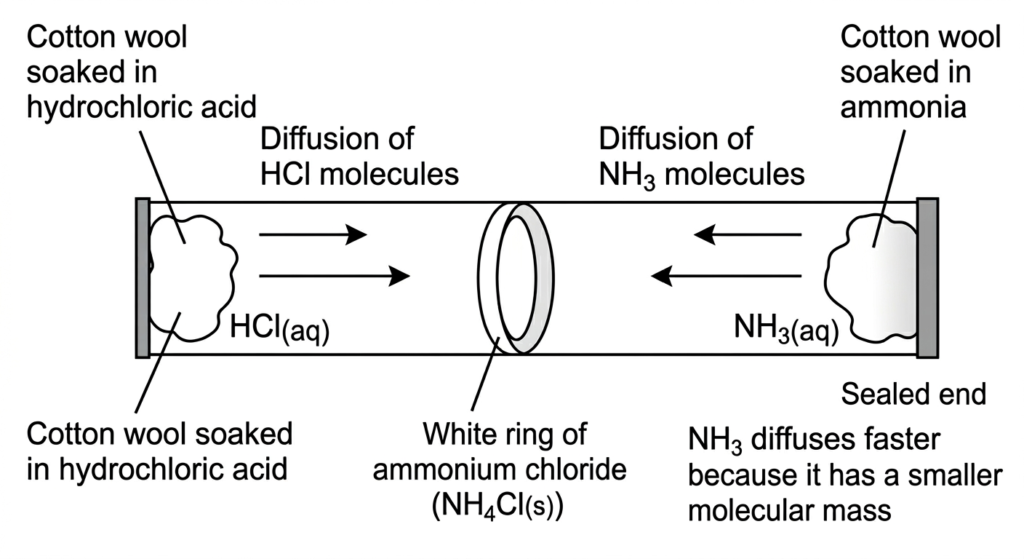
Question 1: Describe an experiment to demonstrate that diffusion occurs in gases and state what the results show.
How to answer: Place a cotton wool soaked in concentrated hydrochloric acid at one end of a long glass tube and a cotton wool soaked in ammonia solution at the other end. Seal both ends. After a few minutes a white ring of ammonium chloride forms inside the tube closer to the hydrochloric acid end. This shows that both gases diffused towards each other and met closer to the acid end. The ring forms closer to the acid end because ammonia molecules are lighter than hydrogen chloride molecules and diffused faster — confirming Graham’s Law.*
Question 2: Hydrogen gas has a relative molecular mass of 2 and oxygen gas has a relative molecular mass of 32. Calculate how many times faster hydrogen diffuses compared to oxygen.
How to answer: Using Graham’s Law: Rate of H₂ ÷ Rate of O₂ = √(M of O₂ ÷ M of H₂) = √(32 ÷ 2) = √16 = 4
Hydrogen diffuses 4 times faster than oxygen.
Question 3: Explain using kinetic theory why gases exert pressure on the walls of their containers.
How to answer: According to kinetic theory gas particles are in constant rapid random motion. As they move they collide with the walls of their container. Each collision exerts a tiny force on the wall. The combined effect of billions of these collisions per second produces a measurable pressure on the walls of the container. The higher the temperature the faster the particles move the more forceful and frequent the collisions and therefore the higher the pressure.*
Conclusion
Kinetic theory is the framework that explains everything from why gases exert pressure to why perfume spreads across a room. Master these definitions and the logic behind particle behaviour and you will be able to answer any kinetic theory or diffusion question in your Chemistry exam.
For more Chemistry revision read our posts on [States of Matter key terms] and [Atomic Structure key terms]. Test yourself with our [Kinetic Theory and Diffusion quiz].