
Why does a hand warmer get hot when you squeeze it? Why does a cold pack get cold instantly when you break it open?
The answer is energy transfer during chemical reactions. Some reactions release heat into the surroundings. Others absorb heat from the surroundings.
Understanding exothermic and endothermic reactions is essential for exam questions on energy changes, reaction profiles, and real-life applications like self-heating cans and instant cold compresses.
Every term below is examinable. Learn them in order.
Exothermic Reaction
A chemical reaction that releases energy to the surroundings. This energy is usually released as heat, but can also be light or sound.
Signs to look for: The reaction vessel feels hot. The temperature of the surroundings increases.
Examples:
- Combustion (burning)
- Respiration
- Hand warmers
- Neutralisation reactions (acid + base)
Energy change: Energy of products is less than energy of reactants. The difference is released.
Endothermic Reaction
A chemical reaction that absorbs energy from the surroundings. The reaction vessel feels cold because heat is being taken in.
Signs to look for: The reaction vessel feels cold. The temperature of the surroundings decreases.
Examples:
- Photosynthesis
- Thermal decomposition (e.g., heating calcium carbonate)
- Instant cold packs
- Melting ice
Energy change: Energy of products is greater than energy of reactants. The difference is absorbed from the surroundings.
Enthalpy Change (ΔH — Delta H)
The heat energy change that occurs during a chemical reaction at constant pressure. Measured in kilojoules per mole (kJ/mol).
Formula symbol: ΔH (Delta H)
Rules to remember:
- Exothermic reaction: ΔH is negative (energy leaves the system)
- Endothermic reaction: ΔH is positive (energy enters the system)
Worked example:
Combustion of methane: CH₄ + 2O₂ → CO₂ + 2H₂O ΔH = –890 kJ/mol
The negative sign tells you this reaction is exothermic — 890 kJ of energy is released per mole of methane burned.
Activation Energy (Ea — E subscript a)
The minimum amount of energy required for a chemical reaction to start. Even exothermic reactions need an initial input of energy to break existing bonds before new bonds can form.
Why it matters: Activation energy is like pushing a rock over a hill. Once it reaches the top, it rolls down the other side by itself.
Exam connection: Catalysts work by lowering the activation energy — making it easier for the reaction to start.
[IMAGE PROMPT FOR NANO BANANA (In-post — keep simple): A clean simple diagram of an energy hill. Draw a line going up to a peak labelled Activation Energy. Then line going down to a lower level labelled Products. Arrow pointing down from peak to lower level labelled Energy Released (Exothermic). No text overload. Clean lines. Black and white textbook style.]
Reaction Profile Diagram (Energy Level Diagram)
A graph showing the energy changes during a chemical reaction. The y-axis represents energy. The x-axis represents the progress of the reaction from reactants to products.
How to read one:
- Reactants start at one energy level
- Products end at another energy level
- Peak represents the transition state (maximum energy)
- Activation energy is the height from reactants to the peak
- Overall energy change (ΔH) is the difference between reactants and products
Exothermic reaction profile: Products lower than reactants
Endothermic reaction profile: Products higher than reactants
Bond Breaking
Energy is required to break chemical bonds. This process is endothermic because energy must be absorbed to overcome the forces holding atoms together.
Key fact: Bond breaking always absorbs energy. It never releases energy.
Example: Breaking the H–H bond in a hydrogen molecule requires +436 kJ per mole.
Bond Formation
Energy is released when new chemical bonds form. This process is exothermic because atoms become more stable when bonded.
Key fact: Bond formation always releases energy. It never absorbs energy.
Example: Forming an H–H bond releases –436 kJ per mole (opposite of breaking it).
Bond Energy (Bond Enthalpy)
The energy required to break one mole of a specific covalent bond in the gas phase. Measured in kJ/mol.
Why it matters: Bond energies allow you to calculate the overall enthalpy change of a reaction without performing an experiment.
Formula for calculating ΔH from bond energies:
ΔH = (Sum of bond energies broken) − (Sum of bond energies formed)
Where:
- Bond energies broken = energy absorbed (positive)
- Bond energies formed = energy released (negative)
Worked example — Combustion of methane (CH₄ + 2O₂ → CO₂ + 2H₂O):
Bonds broken (absorbing energy):
- 4 × C–H = 4 × 412 = 1648 kJ/mol
- 2 × O=O = 2 × 498 = 996 kJ/mol
- Total broken = 2644 kJ/mol
Bonds formed (releasing energy):
- 2 × C=O (in CO₂) = 2 × 743 = 1486 kJ/mol
- 4 × O–H (in 2 H₂O) = 4 × 463 = 1852 kJ/mol
- Total formed = 3338 kJ/mol
ΔH = 2644 − 3338 = –694 kJ/mol
The negative result confirms the reaction is exothermic.
Standard Enthalpy Change (ΔH° — Delta H nought)
The enthalpy change measured under standard conditions:
- Pressure = 1 atmosphere (101 kPa)
- Temperature = 25°C (298 K)
- All substances in their standard states
Why it matters: Standard conditions allow chemists to compare enthalpy changes between different reactions fairly.
Standard Enthalpy of Combustion (ΔH°c)
The enthalpy change when one mole of a substance completely burns in excess oxygen under standard conditions. All combustion reactions are exothermic, so ΔH°c is always negative.
Example: ΔH°c of methane = –890 kJ/mol
Real-life application: Used to compare the energy content of different fuels.
Standard Enthalpy of Formation (ΔH°f)
The enthalpy change when one mole of a compound is formed from its elements in their standard states under standard conditions.
Important rule: The standard enthalpy of formation of any element in its standard state is zero (e.g., O₂(g), H₂(g), C(s) graphite).
Example: ΔH°f of water (H₂O) = –286 kJ/mol
Meaning: H₂(g) + ½O₂(g) → H₂O(l) releases 286 kJ of energy.
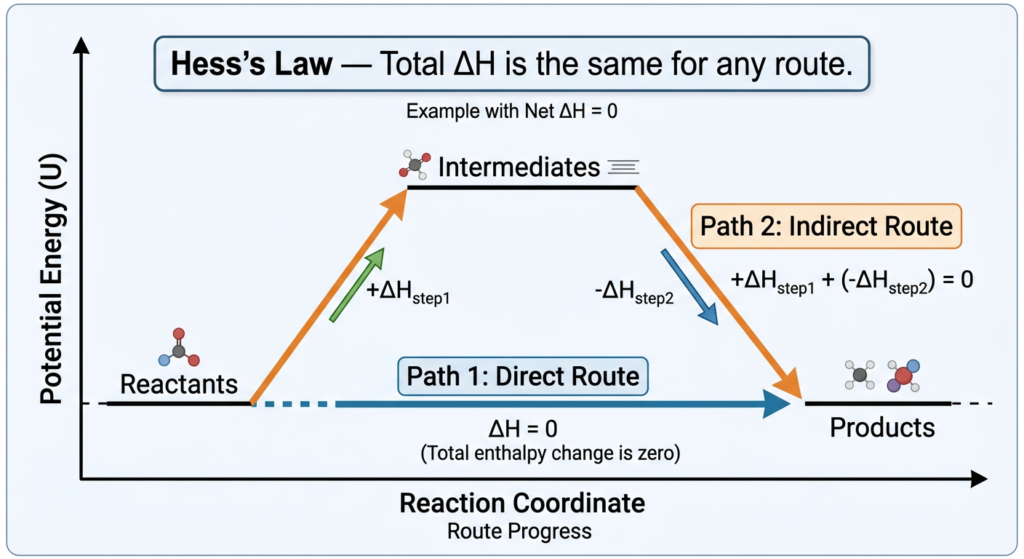
Hess’s Law
The total enthalpy change of a reaction is the same regardless of the route taken. If a reaction can occur in one step or multiple steps, the overall ΔH is identical.
Why it matters: Some reactions cannot be measured directly (e.g., formation of CO from carbon). Hess’s Law allows you to calculate ΔH indirectly using known values.
How to use it: Add the enthalpy changes of each step in an alternative pathway. The sum equals the direct ΔH.
Calorimetry
The experimental measurement of heat energy transferred during a chemical reaction. Used to determine enthalpy changes in the laboratory.
Simple calorimeter setup:
- A container (polystyrene cup reduces heat loss)
- A known mass of water
- A thermometer
- The reactant being tested
Formula for calculating heat change (q):
q = m × c × ΔT
Where:
- q = heat energy absorbed or released (J)
- m = mass of water (g)
- c = specific heat capacity of water (4.18 J/g°C)
- ΔT = temperature change (°C)
Worked example:
50 g of water increases from 20°C to 30°C during a reaction.
q = 50 × 4.18 × 10 = 2090 J (2.09 kJ)
Divide by moles of reactant to find ΔH in kJ/mol.
Exam note: Calorimetry calculations are very common in WAEC, NECO and KCSE papers. Memorise q = m × c × ΔT.
Common Exam Questions
Question 1:
Classify the following as exothermic or endothermic:
- Burning wood
- Photosynthesis
- Neutralisation
- Thermal decomposition
Model answer:
- Burning wood → Exothermic
- Photosynthesis → Endothermic
- Neutralisation → Exothermic
- Thermal decomposition → Endothermic
Question 2:
Calculate the heat released when 100 g of water cools from 40°C to 25°C. (c = 4.18 J/g°C)
Model answer:
ΔT = 40 – 25 = 15°C
q = m × c × ΔT = 100 × 4.18 × 15 = 6270 J (6.27 kJ)
Question 3:
A reaction has an enthalpy change of –500 kJ/mol. Is it exothermic or endothermic? What does the negative sign tell you?
Model answer:
Exothermic. The negative sign means energy is released from the system to the surroundings.
Question 4:
Explain in your own words why bond breaking requires energy but bond formation releases energy.
Model answer:
Bond breaking requires energy to overcome the electrostatic forces holding atoms together. Bond formation releases energy because atoms become more stable when bonded — the excess energy is given off as heat.
Conclusion
Energetics is about tracking energy — where it goes and where it comes from. Remember the two golden rules: bond breaking absorbs energy (endothermic), bond formation releases energy (exothermic). The overall reaction is exothermic if more energy is released than absorbed. Endothermic if more energy is absorbed than released.
For more Chemistry revision, read our posts on [Chemical Formulae and Equations key terms] and Kinetic Theory and Diffusion key terms. Test yourself with our [Energetics quiz].