
Why does food spoil faster in hot weather? Why do powdered sugar dissolve quicker than a sugar cube? Why do chemists grind solids before a reaction?
The answer is rate of reaction — how fast or slow a chemical reaction happens.
Understanding rates of reaction helps you control chemical processes. Pharmaceutical companies speed up drug production. Food preservation slows down spoilage. Exams love questions on the four main factors that affect reaction rate.
Every term below is examinable. Learn them in order.
Rate of Reaction
The speed at which reactants are converted into products in a chemical reaction. Measured as the change in concentration of a reactant or product per unit time.
Formula: Rate = Change in quantity ÷ Change in time
Units: mol/dm³/s (moles per cubic decimetre per second) or cm³/s (gas volume per second) or g/s (mass loss per second)
Two ways to measure rate in the laboratory:
| Method | What you measure | Example |
|---|---|---|
| Disappearing cross | Time for a precipitate to hide a marked cross | Reaction between sodium thiosulphate and acid |
| Gas collection | Volume of gas produced over time | Magnesium reacting with acid |
Exam note: Rate is fastest at the beginning of a reaction when reactant concentrations are highest. Rate slows down as reactants get used up.
Collision Theory
The scientific explanation for how chemical reactions occur and why different reactions happen at different speeds.
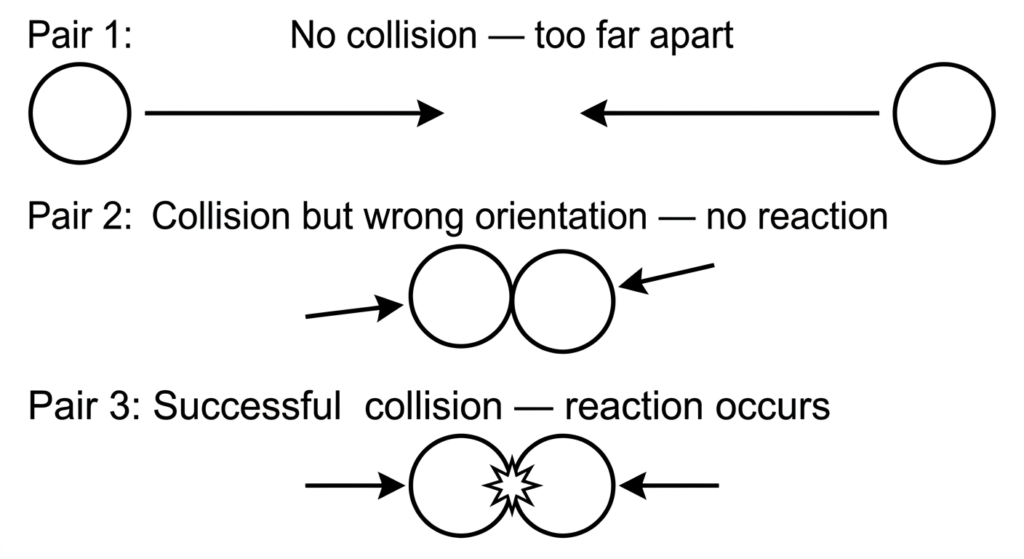
Three conditions for a successful reaction between particles:
- Particles must collide — they cannot react if they never meet
- Collision must have sufficient energy — enough to overcome activation energy
- Correct orientation — particles must hit each other the right way
Why it matters: Anything that increases the number of successful collisions per second increases the rate of reaction.
Activation Energy (Ea)
The minimum energy required for a collision to result in a chemical reaction. Particles colliding with energy less than activation energy simply bounce apart unchanged.
Think of it this way: Activation energy is like a financial threshold. You cannot buy an item if your money is below the price tag. Similarly, particles cannot react if their collision energy is below activation energy.
Exam connection: A catalyst works by lowering activation energy — more collisions become successful at the same temperature.
Factors Affecting Rate of Reaction (The Big Four)
Exam questions always come back to these four factors. Memorise why each factor works — not just the effect.
1. Temperature
Effect: Increasing temperature increases rate of reaction.
Why (two reasons):
- Particles gain kinetic energy and move faster → more frequent collisions
- A larger proportion of particles have energy above activation energy → more successful collisions
Rule of thumb: A 10°C temperature rise roughly doubles the rate of many reactions.
Real-life example: Food spoils faster in a hot kitchen than in a refrigerator because bacteria multiply faster at higher temperatures.
2. Concentration (for solutions)
Effect: Increasing concentration increases rate of reaction.
Why: More reactant particles in the same volume means particles are closer together → more frequent collisions → more successful collisions per second.
Real-life example: Hydrochloric acid at 2 mol/dm³ reacts faster with magnesium than acid at 0.5 mol/dm³ because there are four times as many H⁺ ions in the same space.
3. Pressure (for gases)
Effect: Increasing pressure increases rate of reaction for gases.
Why: Higher pressure pushes gas particles closer together → same number of particles in a smaller volume → more frequent collisions → more successful collisions per second.
Real-life example: A pressure cooker cooks food faster because the high pressure keeps water vapour concentrated above the food, increasing reaction rates.
4. Surface Area (by grinding solids)
Effect: Increasing surface area increases rate of reaction.
Why: Breaking a solid into smaller pieces exposes more particles to the reactant. A powder has much greater surface area than a single large lump → more frequent collisions between solid and reactant particles.
Real-life example: A whole log burns slowly. Wood chips burn faster. Sawdust explodes. Same material — different surface area.

Catalyst
A substance that increases the rate of a chemical reaction without being consumed or permanently changed. Catalysts can be recovered unchanged at the end of the reaction.
How it works: Provides an alternative reaction pathway with a lower activation energy.
Key properties:
- Does not appear in the overall balanced equation
- Works in very small amounts
- Is specific to certain reactions (each catalyst works for one type of reaction)
Examples:
- Manganese(IV) oxide (MnO₂) catalyses decomposition of hydrogen peroxide
- Iron catalyses the Haber process (ammonia production)
- Enzymes are biological catalysts in living organisms
Real-life example: The catalytic converter in a car uses platinum and rhodium to speed up the conversion of toxic exhaust gases into harmless carbon dioxide, water and nitrogen.
Inhibitor (Negative Catalyst)
A substance that slows down or prevents a chemical reaction. Often used to preserve materials or control unwanted reactions.
How it works: Blocks active sites on catalysts or interferes with the reaction pathway.
Real-life example: Antioxidants added to food prevent fats from going rancid. Corrosion inhibitors in engine oil prevent rust formation.
Reaction Pathway Diagram (with Catalyst)
A graph showing how a catalyst lowers activation energy.
What the diagram shows:
- A lower peak on the energy curve when catalyst is present
- Reactants and products remain at the same energy levels (catalyst does not change ΔH)
- The difference between the two peaks is how much activation energy was reduced
Exam tip: In multiple choice questions, the curve with the lower peak is the catalysed reaction. The curve with the higher peak is the uncatalysed reaction.
Measuring Rate of Reaction — Three Methods
Method 1 — Gas collection (for reactions producing gas)
Setup: A gas syringe or inverted measuring cylinder collects gas over water.
Calculate: Rate = Volume of gas ÷ Time
Method 2 — Mass loss (for reactions releasing gas)
Setup: Reaction vessel placed on a balance. Gas escapes, mass decreases.
Calculate: Rate = Change in mass ÷ Time
Method 3 — Disappearing cross (for reactions producing a precipitate)
Setup: A mark is drawn under a beaker containing the reaction mixture. Time how long until the mark is no longer visible.
Calculate: Rate = 1 ÷ Time (inverse of time)
Instantaneous Rate vs Average Rate
| Type | Definition | How to find it |
|---|---|---|
| Average rate | Total change over entire reaction time | Total quantity ÷ Total time |
| Instantaneous rate | Rate at a specific moment in time | Slope of tangent on concentration-time graph |
Exam note: Instantaneous rate is usually faster at the start and slower at the end. The average rate sits somewhere in between.
Common Exam Questions
Question 1:
State four factors that affect the rate of a chemical reaction.
Model answer:
- Temperature
- Concentration (or pressure for gases)
- Surface area of solids
- Presence of a catalyst
Question 2:
Explain, using collision theory, why increasing temperature increases the rate of reaction.
Model answer:
Increasing temperature gives particles more kinetic energy. They move faster, leading to more frequent collisions. Additionally, a larger proportion of particles have energy greater than or equal to activation energy, so more collisions are successful. Both effects increase the rate of reaction.
Question 3:
A student adds 1 g of magnesium powder to 50 cm³ of hydrochloric acid. The reaction produces hydrogen gas and finishes in 30 seconds. The student repeats the experiment using 1 g of magnesium ribbon instead of powder. Predict what happens and explain why.
Model answer:
The magnesium ribbon will take longer than 30 seconds to finish reacting. The ribbon has a smaller surface area than the powder. Fewer magnesium particles are exposed to the acid at any moment. This causes less frequent collisions between magnesium and hydrogen ions, so the reaction rate is slower.
Question 4:
What is a catalyst? How does it increase rate of reaction?
Model answer:
A catalyst is a substance that increases the rate of a chemical reaction without being consumed or permanently changed. It provides an alternative reaction pathway with a lower activation energy. This means more particles have sufficient energy for successful collisions at the same temperature, increasing the reaction rate.
Conclusion
Rate of reaction is controlled by four factors: temperature, concentration, surface area and catalysts. Collision theory explains each one — faster reactions happen when particles collide more often or with greater success. Remember: more frequent collisions + more energy above activation energy = faster reaction.
For more Chemistry revision, read our posts on [Energetics — Exothermic and Endothermic Reactions key terms] and [The Mole Concept key terms]. Test yourself with our [Rates of Reaction quiz].