
Why does salt dissolve in water but oil does not? Why is diamond the hardest natural substance on earth? Why does metal conduct electricity but plastic does not? The answer to all these questions lies in chemical bonding — the way atoms join together to form compounds.
Here are every term and definition you must know for your exam.
Chemical Bond
A force of attraction that holds two or more atoms together. Atoms form bonds in order to achieve a stable electronic configuration — usually a full outer shell of 8 electrons known as the octet rule.
Real life example: The water molecule exists because oxygen and hydrogen atoms bond together. Without chemical bonding there would be no compounds — only individual elements.
Octet Rule
The tendency of atoms to gain, lose or share electrons until they have 8 electrons in their outermost shell — giving them the stable electronic configuration of a noble gas.
Exception: Hydrogen only needs 2 electrons to fill its first shell.
Ionic Bonding
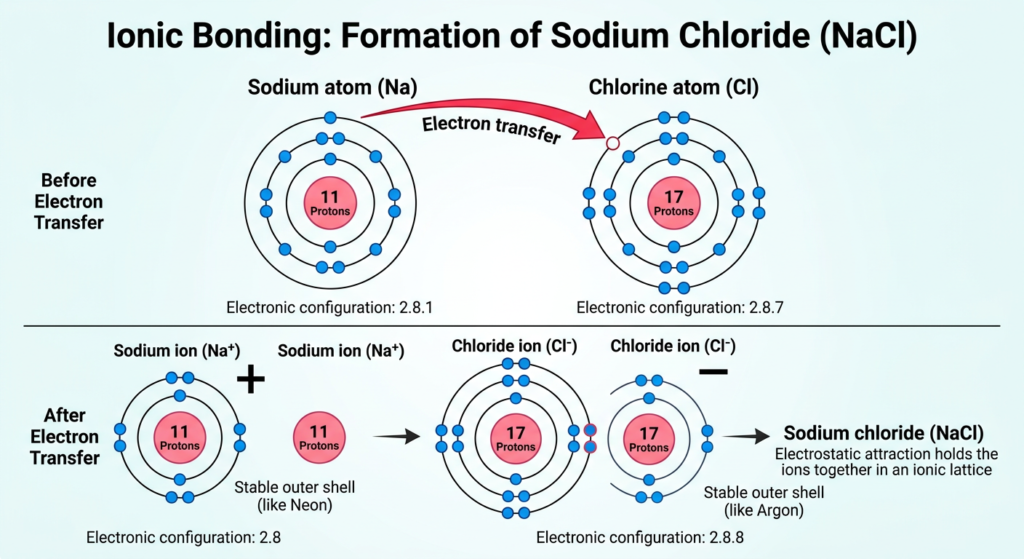
A type of chemical bonding involving the complete transfer of one or more electrons from a metal atom to a non-metal atom. This transfer creates oppositely charged ions that attract each other strongly.
Example: Sodium chloride (table salt) — sodium loses one electron to become Na⁺ and chlorine gains one electron to become Cl⁻. The opposite charges attract forming an ionic bond.
Real life example: The salt you add to your food is held together by ionic bonds.
Covalent Bonding
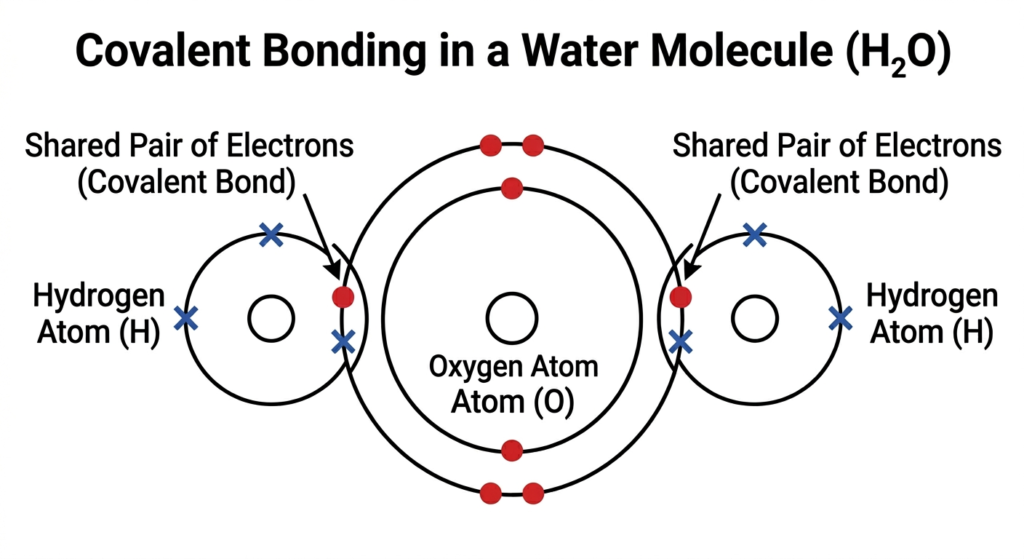
A type of chemical bonding involving the sharing of one or more pairs of electrons between two non-metal atoms. Each atom contributes one electron to the shared pair.
Example: Water (H₂O) — each hydrogen atom shares one electron with oxygen forming two covalent bonds.
Real life example: The oxygen you breathe exists as O₂ molecules held together by a covalent double bond.
Single Bond
A covalent bond formed by the sharing of one pair of electrons between two atoms. Represented by a single line between atoms.
Example: H — H in a hydrogen molecule
Double Bond
A covalent bond formed by the sharing of two pairs of electrons between two atoms. Represented by a double line between atoms.
Example: O = O in an oxygen molecule
Triple Bond
A covalent bond formed by the sharing of three pairs of electrons between two atoms. Represented by a triple line between atoms.
Example: N ≡ N in a nitrogen molecule
Metallic Bonding
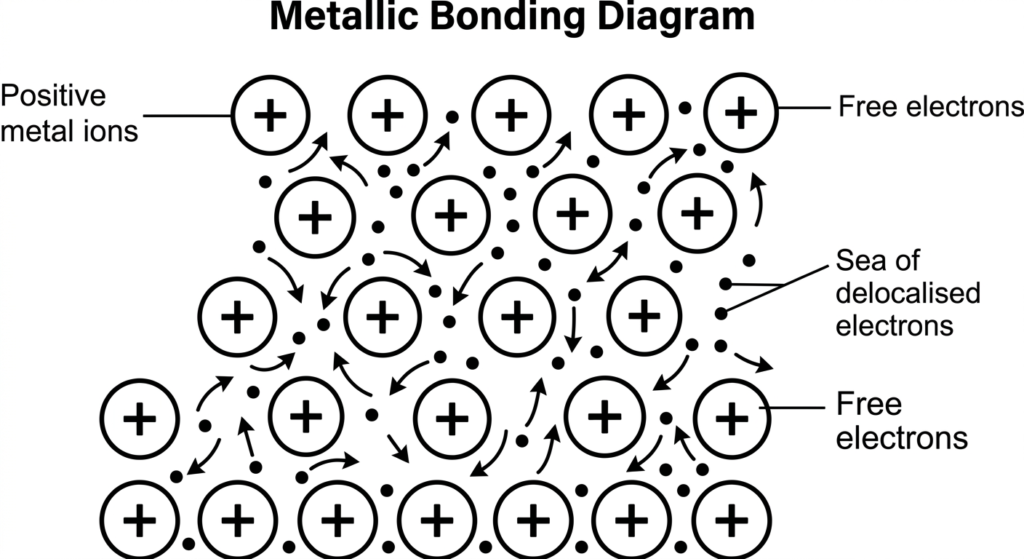
A type of bonding found in metals where positive metal ions are surrounded by a sea of free moving electrons. The electrostatic attraction between the positive ions and the negative electrons holds the metal together.
Real life example: This sea of free electrons is why metals conduct electricity — the electrons can move freely and carry electrical charge.
Electronegativity
The ability of an atom to attract a shared pair of electrons towards itself in a covalent bond. The more electronegative an atom the stronger it pulls shared electrons.
Example: In a water molecule oxygen is more electronegative than hydrogen so it pulls the shared electrons closer to itself.
Polar Covalent Bond
A covalent bond where the shared electrons are not equally shared because one atom is more electronegative than the other. This creates a partial positive charge on one atom and a partial negative charge on the other.
Example: The O-H bond in water is polar because oxygen pulls the shared electrons more strongly than hydrogen.
Non-polar Covalent Bond
A covalent bond where the shared electrons are equally shared between two atoms of the same electronegativity.
Example: The H-H bond in hydrogen gas and the Cl-Cl bond in chlorine gas.
Ionic Compound
A compound formed by ionic bonding between a metal and a non-metal. Ionic compounds form giant lattice structures.
Properties of ionic compounds:
- High melting and boiling points
- Conduct electricity when dissolved in water or melted
- Soluble in water
- Brittle and hard
Examples: Sodium chloride (NaCl), Calcium oxide (CaO), Magnesium chloride (MgCl₂)
Covalent Compound
A compound formed by covalent bonding between non-metal atoms.
Properties of simple covalent compounds:
- Low melting and boiling points
- Do not conduct electricity
- Can be gases, liquids or solids at room temperature
Examples: Water (H₂O), Carbon dioxide (CO₂), Ammonia (NH₃)
Giant Covalent Structure
A structure where millions of atoms are joined together by covalent bonds forming a giant network. These structures have very high melting points.
Examples: Diamond and graphite — both forms of carbon
Real life example: Diamond is the hardest natural substance because every carbon atom is bonded to four others in a giant covalent network making it extremely strong.
Dot and Cross Diagram
A diagram used to show the arrangement of electrons in a chemical bond. Electrons from one atom are shown as dots and electrons from the other atom are shown as crosses.
Coordinate Bond (Dative Bond)
A covalent bond where both electrons in the shared pair come from the same atom.
Example: The bond between ammonia (NH₃) and a hydrogen ion (H⁺) to form the ammonium ion (NH₄⁺)
Common Exam Questions
Question 1: Explain the difference between ionic and covalent bonding and give one example of each.
How to answer: Ionic bonding involves complete transfer of electrons from a metal to a non-metal creating oppositely charged ions that attract. Example: Sodium chloride. Covalent bonding involves sharing of electrons between two non-metal atoms. Example: Water. Key difference — transfer versus sharing of electrons.
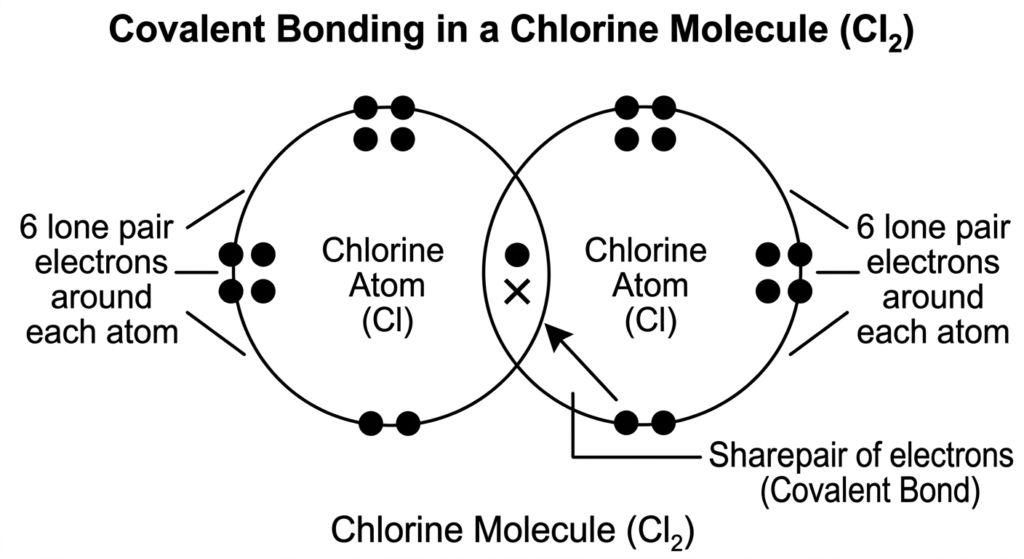
Question 2: Draw a dot and cross diagram to show the bonding in a molecule of chlorine (Cl₂).
How to answer: Draw two chlorine atoms side by side. Each chlorine has 7 outer electrons — show 6 as dots around the atom and 1 as a cross contributing to the shared pair. Show the shared pair between the two atoms. Each chlorine now has 8 outer electrons satisfying the octet rule. Label the shared pair and the single covalent bond.
Question 3: State three properties of ionic compounds and explain each property in terms of their structure and bonding.
How to answer: First property — high melting point. Ionic compounds have strong electrostatic forces between oppositely charged ions in a giant lattice structure requiring a lot of energy to break. Second property — conduct electricity when dissolved or melted. When dissolved or melted the ions become free to move and carry electrical charge. Third property — soluble in water. Water molecules are polar and attract the oppositely charged ions pulling them away from the lattice and into solution.
Conclusion
Chemical bonding explains why substances behave the way they do — why some melt easily, why some conduct electricity, why some dissolve in water. Master these definitions and diagrams and you will be able to answer any bonding question in your Chemistry exam.
For more Chemistry revision read our posts on [Acids and Bases key terms] and [Atomic Structure key terms]. Test yourself with our [Chemical Bonding quiz].