
Have you ever wondered how the shiny chrome finish gets onto a bicycle wheel or how aluminium is extracted from its ore? The answer is electrolysis — the process of using electricity to drive a chemical reaction. It is one of the most practical and commonly tested topics in Chemistry.
Here are every term and definition you must know for your exam.
Electrolysis
The process of decomposing an ionic compound called an electrolyte by passing a direct electric current through it when it is in a molten or aqueous state.
Real life example: Electrolysis is used industrially to extract aluminium from bauxite ore and to electroplate metals like chrome onto bicycle parts and jewellery.
Electrolyte
An ionic compound that can conduct electricity when dissolved in water or in its molten state. Electrolytes conduct electricity because they contain free moving ions.
Examples: Sodium chloride solution, copper sulphate solution, molten lead bromide
Non-electrolytes: Sugar solution, distilled water, alcohol — these do not contain free ions and cannot conduct electricity.
Electrode
A conductor through which electric current enters or leaves the electrolyte. Electrodes are usually made of carbon graphite or platinum — inert materials that do not react with the electrolyte.
Anode
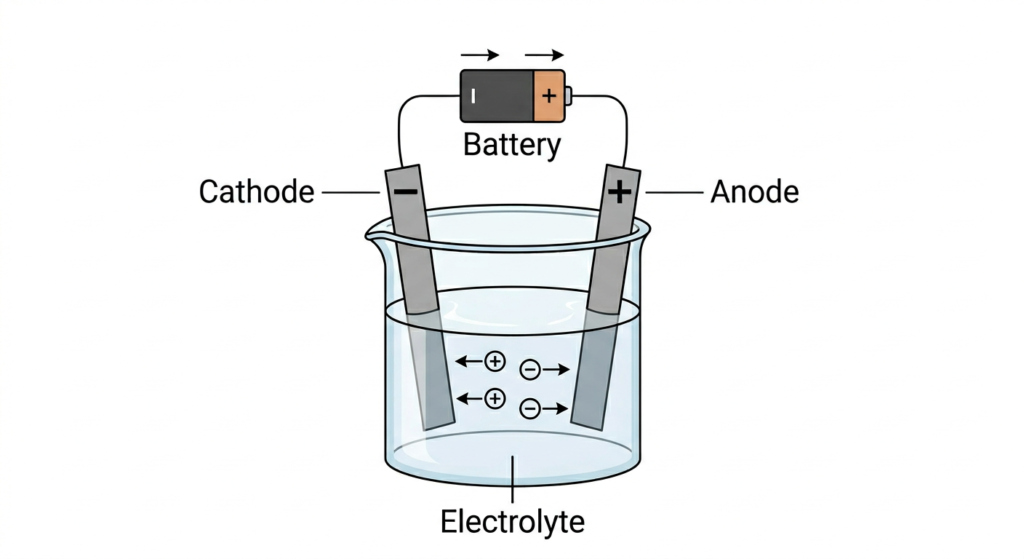
The positive electrode in electrolysis. Connected to the positive terminal of the battery. Negatively charged ions called anions are attracted to the anode and lose electrons here.
Memory tip: Anode = A positive. Both start with A.
Cathode
The negative electrode in electrolysis. Connected to the negative terminal of the battery. Positively charged ions called cations are attracted to the cathode and gain electrons here.
Memory tip: Cathode = C negative. C for Cations go to Cathode.
Anion
A negatively charged ion that moves towards the anode during electrolysis.
Examples: Chloride ion (Cl⁻), Hydroxide ion (OH⁻), Sulphate ion (SO₄²⁻)
Cation
A positively charged ion that moves towards the cathode during electrolysis.
Examples: Sodium ion (Na⁺), Copper ion (Cu²⁺), Hydrogen ion (H⁺)
Oxidation
The loss of electrons at the anode during electrolysis. Oxidation always occurs at the anode.
Memory tip: OIL RIG — Oxidation Is Loss, Reduction Is Gain
Reduction
The gain of electrons at the cathode during electrolysis. Reduction always occurs at the cathode.
Half Equation
An equation that shows what happens at each electrode during electrolysis — either the loss or gain of electrons.
Example at cathode: Cu²⁺ + 2e⁻ → Cu (copper is deposited) Example at anode: 2Cl⁻ → Cl₂ + 2e⁻ (chlorine gas is released)
Electrolytic Cell
The complete apparatus used for electrolysis consisting of the electrolyte, two electrodes, a battery and connecting wires.
Discharge of Ions
The process by which ions lose or gain electrons at the electrodes and are converted into neutral atoms or molecules.
Preferential Discharge
When a solution contains more than one type of ion, only certain ions are discharged at each electrode. The ion discharged depends on its position in the electrochemical series and its concentration.
Example: In dilute sodium chloride solution hydroxide ions are preferentially discharged at the anode instead of chloride ions because their concentration is lower.
Electrochemical Series
A list of ions arranged in order of their tendency to be discharged during electrolysis. Ions lower in the series are more easily discharged.
At the cathode — ions lower in the series are discharged first:
- Cu²⁺ discharged before H⁺ which is discharged before Na⁺
At the anode — ions lower in the series are discharged first:
- Cl⁻ discharged before OH⁻ which is discharged before SO₄²⁻
Electroplating
The process of using electrolysis to coat one metal with a thin layer of another metal. Used to improve appearance, prevent corrosion and increase durability.
Real life example: Bicycle parts, jewellery and cutlery are often electroplated with chrome, silver or gold.
Setup for electroplating:
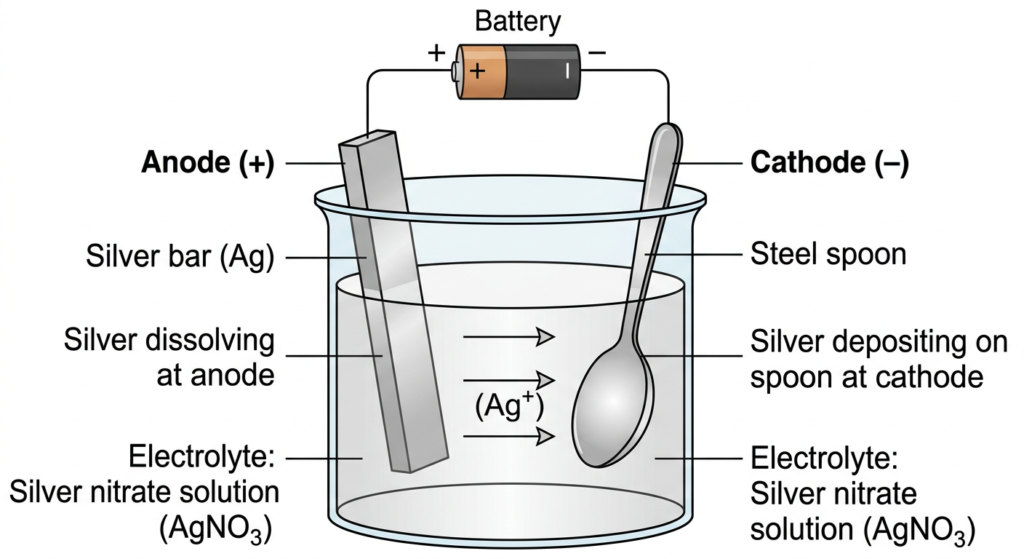
- Cathode = object to be plated
- Anode = metal used for plating
- Electrolyte = solution of the plating metal salt
Electrolytic Refining
The process of purifying metals using electrolysis.
Example: Purifying copper — impure copper is used as the anode, pure copper is used as the cathode and copper sulphate solution is the electrolyte. Pure copper dissolves from the anode and deposits on the cathode.
Faraday’s Laws of Electrolysis
First Law: The mass of substance deposited or liberated at an electrode is directly proportional to the quantity of electricity passed through the electrolyte.
Second Law: The mass of substance deposited or liberated is proportional to the equivalent mass of the substance.
Common Exam Questions
Question 1: Define electrolysis and state two industrial applications of electrolysis.
How to answer: Define electrolysis as the decomposition of an ionic compound by passing direct electric current through it in molten or aqueous state. Two industrial applications — extraction of aluminium from bauxite ore and electroplating of metals such as chrome plating on bicycle parts and jewellery.*
Question 2: During the electrolysis of copper sulphate solution using copper electrodes describe what happens at each electrode and write half equations for each reaction.
How to answer: At the cathode — copper ions gain electrons and are deposited as copper metal. Half equation: Cu²⁺ + 2e⁻ → Cu. At the anode — copper atoms lose electrons and dissolve into the solution as copper ions. Half equation: Cu → Cu²⁺ + 2e⁻. Overall the anode dissolves and copper deposits on the cathode keeping the concentration of copper sulphate solution constant.
Question 3: Explain how you would electroplate a steel spoon with silver. State the anode, cathode and electrolyte you would use.
How to answer: Cathode = steel spoon to be plated. Anode = pure silver. Electrolyte = silver nitrate solution. Connect both to a battery with the spoon as cathode and silver as anode. Pass current through the circuit. Silver ions from the solution are attracted to the cathode and deposit as silver metal on the spoon. The silver anode dissolves to replenish the silver ions in the solution.*
Conclusion
Electrolysis is one of the most practical topics in Chemistry with real world applications you encounter every day. Master these definitions and understand what happens at each electrode and you will be well prepared for any electrolysis question in your exam.
For more Chemistry revision read our posts on [Chemical Bonding key terms] and [Atomic Structure key terms]. Test yourself with our [Electrolysis quiz].