
Water can exist as ice in your freezer, as liquid in your cup and as steam rising from a pot of boiling food. These three forms of water perfectly illustrate the three states of matter. Everything around you — the air you breathe, the food you eat, the ground you walk on — exists in one of these three states. Understanding them is the foundation of all Chemistry.
Here are every term and definition you must know for your exam.
States of Matter
Matter is anything that has mass and occupies space. All matter exists in one of three physical states — solid, liquid or gas. The state of a substance depends on temperature and pressure.
Solid
A state of matter in which particles are closely packed together in a fixed regular arrangement. Solids have a definite shape and volume that does not change unless a force is applied.
Properties of solids:
- Fixed shape and volume
- Particles vibrate in fixed positions but do not move freely
- Cannot be compressed
- High density
- Strong forces of attraction between particles
Real life example: A block of ice, a stone, a piece of chalk — all solids that maintain their shape.
Liquid
A state of matter in which particles are close together but not in a fixed arrangement. Liquids have a definite volume but take the shape of their container.
Properties of liquids:
- No fixed shape — takes shape of container
- Fixed volume
- Particles move freely but remain close together
- Cannot be compressed significantly
- Less dense than solids in most cases
Real life example: Water, palm oil and petrol are all liquids that take the shape of whatever container they are poured into.
Gas
A state of matter in which particles are widely spread apart and move randomly at high speed. Gases have no fixed shape or volume and expand to fill any container.
Properties of gases:
- No fixed shape or volume
- Particles move rapidly and randomly
- Can be compressed easily
- Very low density
- Weak forces of attraction between particles
Real life example: The air in a football can be compressed into a smaller space — this is possible because gas particles are far apart and can be pushed closer together.
Kinetic Theory of Matter
The theory that explains the behaviour of matter in terms of the movement of its particles. The main points are:
- All matter is made up of tiny particles — atoms, molecules or ions
- These particles are in constant random motion
- The higher the temperature the faster the particles move
- Particles collide with each other and with the walls of their container
- There are forces of attraction between particles that vary in strength depending on the state
Brownian Motion
The random irregular movement of small particles suspended in a liquid or gas caused by collisions with the surrounding molecules. Brownian motion provides evidence that particles in matter are in constant random motion.
Real life example: The random movement of dust particles visible in a beam of sunlight through a window is similar to Brownian motion.
Diffusion
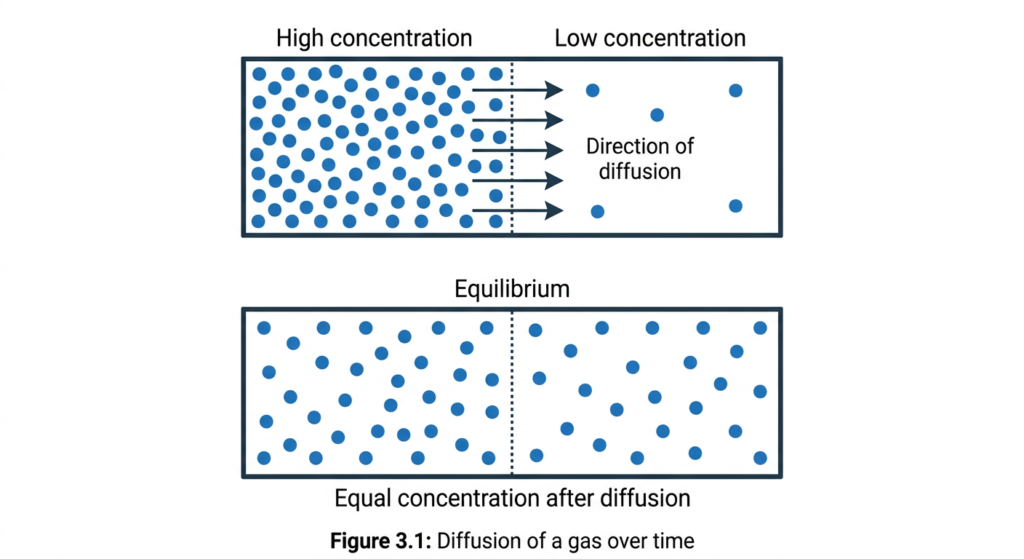
The movement of particles from a region of high concentration to a region of low concentration until the concentration is equal throughout. Diffusion occurs in both liquids and gases.
Real life example: When you open a bottle of perfume in one corner of a room everyone in the room can eventually smell it — the perfume particles diffuse through the air.
Changes of State
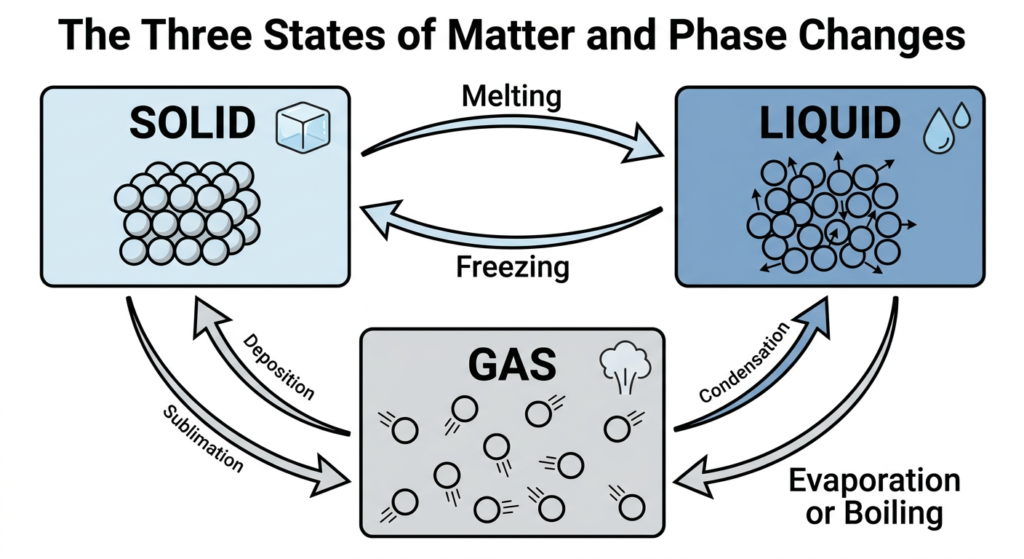
Matter can change from one state to another when energy is added or removed. These changes are physical changes — no new substance is formed.
Melting
The change of state from solid to liquid when energy is added. Occurs at a fixed temperature called the melting point.
Real life example: Ice melts at 0°C to form liquid water.
Melting Point
The fixed temperature at which a solid changes to a liquid at standard pressure. Pure substances have sharp melting points while impure substances melt over a range of temperatures.
Uses of melting point: Used to test the purity of a substance — a pure substance melts at a precise temperature while an impure one melts over a range.
Freezing
The change of state from liquid to solid when energy is removed. Occurs at the same temperature as the melting point — called the freezing point.
Real life example: Water freezes at 0°C to form ice.
Boiling
The change of state from liquid to gas throughout the liquid when energy is added. Occurs at a fixed temperature called the boiling point. Bubbles of vapour form throughout the liquid.
Boiling Point
The fixed temperature at which a liquid changes to a gas at standard pressure.
Example: Water boils at 100°C at standard atmospheric pressure.
Note: Boiling point decreases at higher altitudes where atmospheric pressure is lower. This is why food takes longer to cook on a mountain top.
Evaporation
The change of state from liquid to gas at the surface of a liquid at temperatures below the boiling point. Evaporation occurs at all temperatures and causes cooling.
Difference between evaporation and boiling: Evaporation occurs at the surface only and at any temperature. Boiling occurs throughout the liquid at a fixed temperature.
Real life example: Wet clothes dry through evaporation — water evaporates from the surface of the clothes into the air.
Condensation
The change of state from gas to liquid when energy is removed. The opposite of evaporation.
Real life example: Water droplets on a cold bottle of water on a hot day form through condensation — water vapour in the warm air condenses on the cold surface.
Sublimation
The change of state directly from solid to gas without passing through the liquid state.
Examples: Iodine and dry ice (solid carbon dioxide) sublime.
Real life example: Mothballs placed in a wardrobe slowly disappear over time — they sublime directly from solid to gas.
Latent Heat
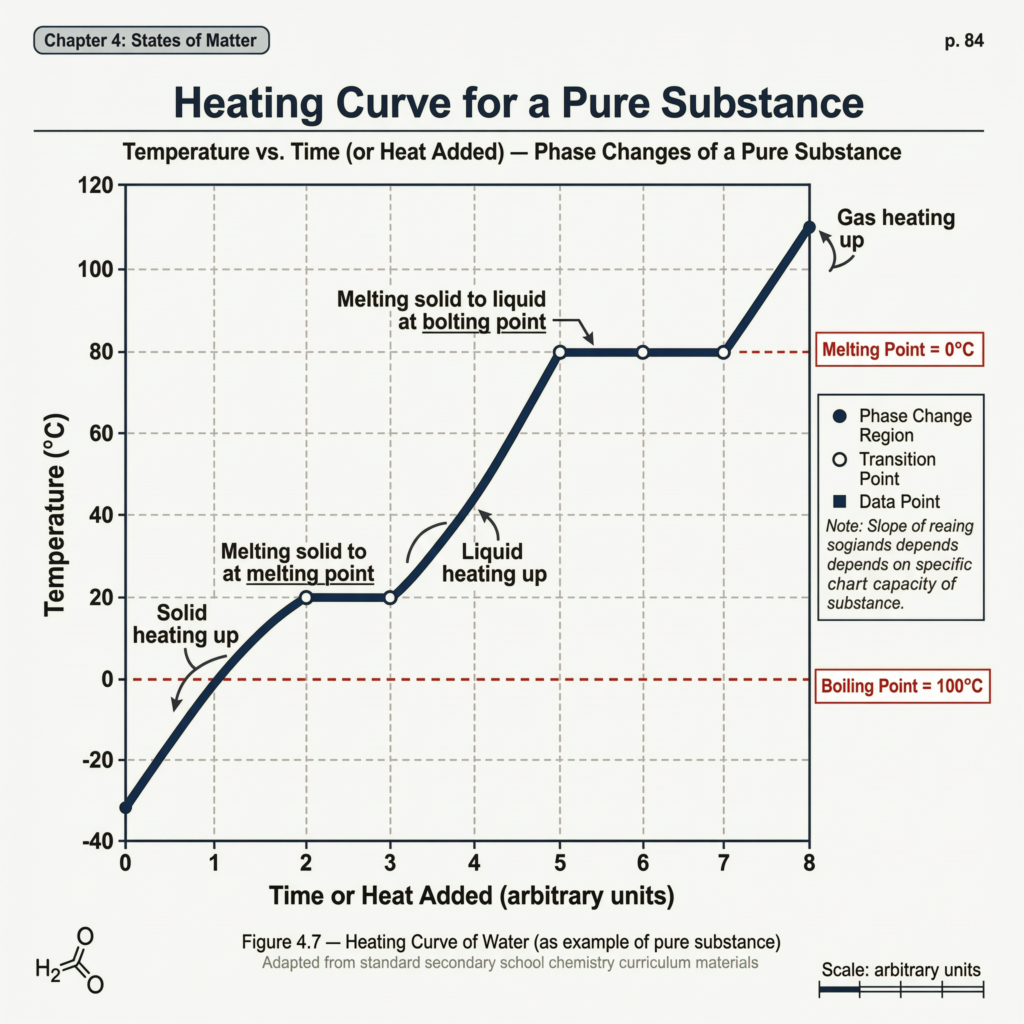
The energy absorbed or released during a change of state at constant temperature. The temperature does not change during a change of state even though energy is being added or removed.
- Latent heat of fusion — energy needed to melt a solid at its melting point
- Latent heat of vaporisation — energy needed to boil a liquid at its boiling point
Heating Curve
A graph showing how the temperature of a substance changes as heat is added over time. The flat sections of the graph show where changes of state are occurring — temperature remains constant while energy is used to break forces of attraction between particles.
Common Exam Questions
Question 1: Explain using the kinetic theory why a gas can be compressed but a solid cannot.
How to answer: In a gas particles are widely spread apart with large empty spaces between them. When pressure is applied the particles can be pushed closer together into these empty spaces — this is compression. In a solid particles are already packed closely together in a fixed arrangement with very little space between them. There is no room for the particles to move closer together so solids cannot be compressed.
Question 2: The melting point of substance X is 45°C and its boiling point is 197°C. State the physical state of substance X at each of the following temperatures: 20°C, 100°C, 250°C.
How to answer: At 20°C — below the melting point of 45°C — substance X is a solid. At 100°C — above the melting point of 45°C but below the boiling point of 197°C — substance X is a liquid. At 250°C — above the boiling point of 197°C — substance X is a gas.
Question 3: Explain what happens to the temperature of a substance during melting and explain why.
How to answer: During melting the temperature of a substance remains constant even though heat is being added. This is because the energy being added is used to break the forces of attraction between the particles of the solid rather than to increase the kinetic energy of the particles. This energy is called the latent heat of fusion. Only after all the solid has melted does the temperature begin to rise again.
Conclusion
States of matter is one of the most fundamental topics in Chemistry and appears in almost every exam. Master the properties of each state, understand the changes of state and know how to interpret a heating curve and you will be well prepared for any question on this topic.
For more Chemistry revision read our posts on [Kinetic Theory and Diffusion] and [Separation Techniques key terms]. Test yourself with our [States of Matter quiz].